Sponsorship
We have reviewed our approach to sponsorship donations, following feedback from parties. This is our new guidance on sponsorship which will apply to sponsorship accepted from 1 January 2027 onwards.
For our current sponsorship guidance, please see the party donations and loans guidance:
Which donations are covered by the law?
Under the Political Parties, Elections and Referendums Act 2000 (PPERA), a donation is money, goods or services given to a party with a value of over £500.1
The types of donations regulated under the law are:
- gifts of money or other property (items, goods or services)2
- membership or affiliation payments3
- paying for expenses incurred directly or indirectly by the party4
- free or specially discounted use of items, goods, services or facilities5
- sponsorship of an event, publication, study or research6
Commercial and non-commercial terms
On commercial terms means where the item, goods or service is being provided at its market value.
Some donations are only regulated if they are provided to the party on non-commercial terms. This includes free or specially discounted use of items, goods, services or facilities.
In contrast, sponsorship may include transfers of money or property to the party on commercial terms. The law covers sponsorship and other types of donations to provide transparency on different methods of financial support provided to the party. Please see Sponsorship for more information.
Donations of £500 or less
Donations of £500 or less are outside the scope of PPERA and you do not need to record or report them.7
However, you must be alert to situations where it appears that a donor is attempting to evade the law. It is an offence to attempt to evade the controls on donations.8 For example, if a number of donations of £400 are made from the same source in similar circumstances in an attempt to evade the permissibility rules.
If you think this may be happening, you should contact us for advice.
- 1. Section 50 and section 52(2)(b) Political Parties, Elections and Referendums Act 2000 (PPERA) ↩ Back to content at footnote 1
- 2. S.50(2)(a) PPERA ↩ Back to content at footnote 2
- 3. S.50(2)(c) PPERA ↩ Back to content at footnote 3
- 4. S.50(2)(d) PPERA ↩ Back to content at footnote 4
- 5. S.50(2)(f) PPERA ↩ Back to content at footnote 5
- 6. S.50(2)(b) PPERA ↩ Back to content at footnote 6
- 7. S.52(2)(b) PPERA ↩ Back to content at footnote 7
- 8. S.61 PPERA ↩ Back to content at footnote 8
What is sponsorship?
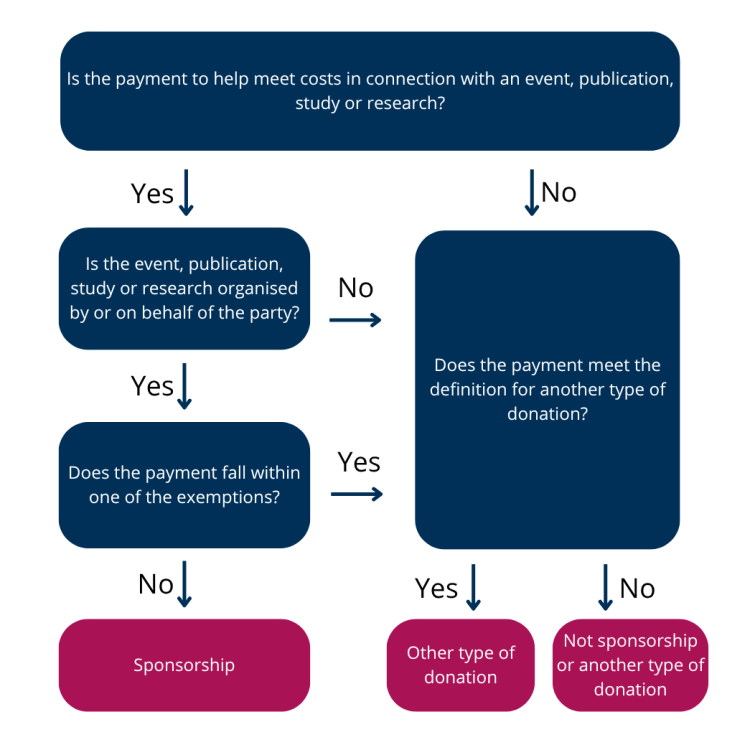
Sponsorship is any money or other property (items, goods or services) provided to the party to help, or which must reasonably be assumed to help, meet costs in connection with:
- any conference, meeting or other event (including digital conferences or events)
- the preparation, production, or distribution of a publication (print or digital), or
- any study or research
where these are organised by or on behalf of the party.1
Sponsorship may include transfers of money or property to the party on commercial terms. Even if the party and the sponsor view this as a commercial arrangement, sponsorship is a type of donation. The same permissibility and reporting requirements apply to donations received as sponsorship as with other donations.
Sponsorship is regulated because it has a similar effect as other types of donations. For both sponsorship and other types of donations, the law provides transparency on financial benefits provided to the party.
When you report a sponsorship donation to us, you must identify it as sponsorship.2 This helps voters understand the nature of these payments by distinguishing them from other types of donations.
When does a payment help meet costs?
In most cases, a payment made in connection with an event, publication or research may reasonably be assumed to be to help meet its costs. If one of the purposes of the payment was to help the party meet these costs, or must reasonably be assumed to be to help the party meet these costs, this is sponsorship.
It is important to consider how a reasonable person would see the payment and whether they would think one of the purposes of the payment is to help the party meet these costs.
A payment does not have to be used to meet costs directly to count as sponsorship.
Valuing sponsorship
The value of the sponsorship is the full amount of the payment received from the sponsor. You must not make any deductions for any potential benefit to the sponsor or where the actual costs of the event, publication, study or research are less than the amount received from the sponsor.3
- 1. Section 51(1) Political Parties, Elections and Referendums Act 2000 (PPERA) ↩ Back to content at footnote 1
- 2. Registered Parties’ Quarterly and Weekly Donation Reports (Additional Information) Regulations 2007 ↩ Back to content at footnote 2
- 3. S.53(3) PPERA ↩ Back to content at footnote 3
Which payments don’t count as sponsorship?
The following payments do not count as sponsorship:1
- admission charges for conferences, meetings or other events
- the purchase price of, or any other charge to access, publications
- commercial rate payments for adverts in publications
- payments for conference stands within the maximum rate set by the Electoral Commission
While these payments do not count as sponsorship, they may instead be a different type of donation to the party. If a payment is not sponsorship, you should consider whether the payment is another type of donation, such as a gift of money or money spent paying costs incurred by the party.
The Commission considers that sales of party branded merchandise at events are not sponsorship.
Admission charges
Admission charges for your events will not count as sponsorship. For example, party conference entry passes or an admission fee to attend an event organised by or on behalf of the party.
However, if you charge or are paid more than the value of the service provided at the event, this extra amount will be a donation if this is more than £500.2 Please see common examples of sponsorship for more guidance and examples of this.
Adverts in party publications
Payments made to place adverts in your party publications at the commercial rate will not count as sponsorship. For example, publications will include conference handbooks, directories or other printed agendas, books or magazines.
This exemption only applies to advertising in party publications and does not include advertising elsewhere, such as conference banners, or on conferences passes and lanyards.
To work out whether payments made to place adverts in a party publication are a donation, you must work out the commercial rate to charge for these adverts. The commercial rate will be the average rates for similar adverts offered by commercial providers.
If someone pays more than the commercial rate for an advert in a party publication, the full amount of the payment will be sponsorship.3 This is because the exemption would no longer apply.
Please see the next page for guidance on conference stands.
- 1. Section 51(3) Political Parties, Elections and Referendums Act 2000 (PPERA) ↩ Back to content at footnote 1
- 2. S.50(3) and s.52(2)(b) PPERA ↩ Back to content at footnote 2
- 3. S.53(3) PPERA ↩ Back to content at footnote 3
Conference stands
Under the law, the Electoral Commission can set a maximum rate for the hire of exhibition stands at your party conferences. Hiring conference stands up to these rates will not count as sponsorship or any other type of donation.1 We have set maximum rates for physical conference stands and digital conference stands.
Physical conference stands
Payments of up to £15,000 (excluding VAT) for a 3m x 3m/9 square meter physical exhibition stand at your conferences will not be sponsorship or any other type of donation. The maximum rate that that can therefore be charged is effectively £1,666.67 per square meter.
If you are hiring out larger stands, you can charge more than £15,000, provided this is charged on a pro-rata basis. You do not need to charge on a pro-rata basis if you are hiring out smaller stands, provided the price you set is equal or less than the rate we have set.
For example, Party A has a 5m x 5m/25 square meter exhibition stand at its party’s conference. It calculates the maximum price that can be set for this size stand to remain exempt from the donation controls:
£15,000/9 square meters = £1,666.67
£1,666.67 x 25 square meters = £41,666.75.
A payment of up to £41,666.75 (excluding VAT) for a 5m x 5m/25 square meter conference stand will not be a donation to the party.
Any amount you receive above this rate must be treated as sponsorship, and therefore as a donation to the party. This is because the exemption for conference stands only applies to payments made up to the maximum rate we set. You should not treat the entire payment as sponsorship.
If you charge a higher rate for physical stands, we expect you to keep sufficient records of the transaction, including the stand’s size, the price charged, and how you calculated the price. We may ask to see your record keeping for our assurance purposes.
For example, Party B hires out a 6m x 6m/36sqm exhibition stand at its party conference. The maximum price that can be set for this size stand to remain exempt from the donation controls is:
£1,666.67 x 36 square meters = £60,000.12.
Party B charges £62,500 (excluding VAT) for the conference stand. The party must treat the £2,499.88 as sponsorship.
Digital conference stands
If a political party hosts a digital conference and makes available live promotional space on the online platform it is using, it may be considered a digital conference stand.
To be a digital conference stand, the following features must be present:
- the digital stand must be available for hire for the duration of the conference
- there must be some level of real-time interaction between attendees and the exhibitor
- it must be live
- an advert or banner (or something similar) must be included on the conference website or hosting platform (an advert on a website without the other elements would not be a digital conference stand)
Payments of up to £7,000 (excluding VAT) for a digital stand do not need to be treated as sponsorship or any other type of donation.
Any amount you receive for a digital stand exceeding £7,000 (excluding VAT) must be treated as sponsorship, and therefore as a donation to the party. This is because the exemption for conference stands only applies to payments made up to the maximum rate we set. You should not treat the entire payment as sponsorship.
If you charge a higher price than £7,000 (excluding VAT) for a digital stand, we expect you to keep sufficient records to show this transaction. This includes details of the price you applied to it and how you calculated the price. We may ask to see your record keeping for our assurance purposes.
- 1. Section 52(3) Political Parties, Elections and Referendums Act 2000 (PPERA) ↩ Back to content at footnote 1
Common examples of sponsorship
Conference advertising
Examples of advertising that are sponsorship include:
- advertising banners displayed in the conference hall and venues
- advertising leaflets included in conference packs for delegates
- advertising on the lanyards for conference passes
- advertising included in conference pack folders
For example, a company pays a party £15,000 to have its name and logo on the lanyards for the conference pass given to every person who attends the conference. As one of the purposes of the payment may reasonably be assumed to be to help the party meet costs in connection with hosting the conference, this is sponsorship.
The party must check the company is a permissible donor before accepting the donation and report the donation to the Commission, as it is over the £11,180 reporting threshold.
Conference dinners and receptions
Payments provided towards meeting the costs of a dinner or reception organised by or on behalf of the party will be sponsorship.
Example A
A firm pays £30,000 to sponsor a conference dinner organised by the party. This includes the company’s name and logo being displayed on banners at the dinner and on the menu, and a table at the dinner for the company and its guests.
The party must check the company is a permissible donor before accepting the donation and report the entire amount to the Commission, as it is over the reporting threshold.
Example B
A company pays £15,000 to hire a conference hall for a party to host an event. The company will have its name logo displayed in the hall during the event. The party must check the company is a permissible donor before accepting the donation and report the entire amount to the Commission, as it is over the reporting threshold.
If you sell tickets to a dinner or reception you have organised, or one that is organised on your behalf, this will not be sponsorship because admission charges to party events do not count as sponsorship.
However, it is important you work out the market value of the service provided at the event, as the difference between the value and the amount you are paid will be a non-sponsorship donation if this is more than £500.1
For example, a party sells tickets to its conference dinner. The costs of the event are as follows:
- market value of the service provided per person: £30
- ticket price: £120
In this example, the difference between the market value of the service provided per person and the amount charged is £90. As the value of the donation in this case is not over £500, a donation has not been made to the party.
At the same event, the party also sells tables for 10 guests.
- market value of each table: £300
- table price: £1,000
In this example, the difference between the value of each table and the amount charged is £700. Anyone purchasing a table at the conference dinner will therefore be donating £700 to the party. As the party can only accept donations of more than £500 from a permissible source, only those that are permissible will be able to purchase a table.
Conference packages
If you offer conference packages, where someone can purchase a combined package of items for an event together, you will need to consider each part of the package to assess whether it is sponsorship, or another type of donation. Some elements may not count as sponsorship, such as an admission charge.
Where some elements of a package are sponsorship and others are not sponsorship but another type of donation, you should treat the entire donation amount as sponsorship and report this as one sponsorship donation, where required.
Example A
A company purchases a package for the conference which includes:
- four conference passes
- four tickets to the conference dinner
- use of the company’s logo on delegates’ packs
- an advert in the conference directory.
The conference passes and tickets to the conference dinner are exempt from being sponsorship as admission charges for events do not count as sponsorship. However, the cost of hosting the dinner is £50 per person and the party has sold tickets at £150 each. The difference between the value of the dinner and the amount paid for each ticket is £100. This part of the package is a donation of £400 to the party, as the sponsor has bought four tickets.
The party has sold the adverts in the conference directory at the commercial rate. Payments for the adverts also do not count as sponsorship as payments for adverts in party publications at the commercial rate are one of the sponsorship exemptions.
The party have also sold an advert with the company’s logo on the packs for delegates at £5,000. The full amount is sponsorship.
In total, the value of the donation to the party is £5,400. The full amount should be treated as sponsorship.
Example B
A company purchases a package for a conference which includes:
- two tickets to the conference reception
- use of the company’s logo within the venue
- an advert in the conference directory.
The tickets to the conference reception are not sponsorship as admission charges for events do not count as sponsorship under the law. However, the market value of the service provided at the reception is £80 per person and the party has sold tickets at £500 each. The difference between the value of the service provided and the amount paid for each ticket is £420. This part of the package is a donation of £840 to the party, as the sponsor has bought two tickets.
The party have sold the use of the company’s logo on the packs for delegates at £5,000. The full amount is sponsorship.
The sponsor has paid £8,000 for the advert in the conference directory which is above the commercial rate for an advert in a party publication. The full payment for the advert is also sponsorship.
In total, the value of the donation to the party is £13,840. The full amount should be treated as sponsorship and reported to the Commission, as this is over the £11,180 reporting threshold.
Publications
If you receive payments towards the costs of preparing, producing, or distributing a publication organised by or on behalf of your party, this will be sponsorship.
For example, a company pays £12,000 to sponsor a party publication. This includes the company’s name and logo being displayed in the publication and being promoted as a joint research partner.
The party must check the company is a permissible donor before accepting the donation and report it to the Commission, as it is over the £11,180 reporting threshold.
If you sell adverts in your publications at the commercial rate, this will not be sponsorship because payments made to place adverts in your publications at the commercial rate do not count as sponsorship.
To work out whether payments made to place adverts in a publication are a donation, you must work out the commercial rate to charge for these adverts. The commercial rate will be the average rates for similar adverts offered by commercial providers.
If someone pays more than the commercial rate for an advert in a publication, the full amount of the payment will be sponsorship. This is because the exemption would no longer apply.
- 1. Section 50(3), s.52(2)(b) and s.53(2) Political Parties, Elections and Referendums Act 2000 ↩ Back to content at footnote 1
Conference fringe events
The sponsorship controls only apply to events organised that are organised by, or on behalf of, the party. These include fringe events taking place at your party conferences.
Fringe events organised externally
Most fringe events will be organised by external organisations, rather than the party itself. Payments towards meeting the costs of events organised externally will not be sponsorship.
In some cases, you may offer support to these organisations or offer to make payments on their behalf. For example, you may offer staff support, marketing or catering at the event or pay the conference centre directly for the room hire. The organisation may also pay you to provide advertising at the event.
If you provide support or other services at these events, you must ensure these services are valued at a comparable market rate. Any payments you receive for these services at the market rate will be commercial income and will not be a donation to the party. However, if you charge or are paid more than the market rate of the service you provide, this extra amount will be a donation if this is more than £500.1
Fringe events organised by the party
Sometimes your party, or sections of your party may host fringe events. If this is the case, payments provided to help you meet the costs of these will be sponsorship.
Example A
A healthcare campaign group organises and hosts a fringe event at a party conference to discuss the future of the NHS. The campaign group pays the party the costs of hiring the room and providing refreshments at a comparable market rate.
As the event is organised by the healthcare campaign group, not the party, the payments for this event are not sponsorship. The payments to the party for the room hire and refreshments are commercial income and are not donations.
Example B
A party organises an event providing delegates with the opportunity to meet the party’s leader. A building society pays the party to have its logo at the event and on the fringe listing for the event at a total cost of £8,000.
As the event is organised by the party, the £8,000 in payment from the building society to help the party meet the costs of the event are sponsorship. This is a donation to the party, as the value of the sponsorship is more than £500.
- 1. Section 50(3) and section 52(2)(b) Political Parties, Elections and Referendums Act 2000 (PPERA) ↩ Back to content at footnote 1