About this guidance
about this gudiance
The guidance has been prepared by the Electoral Commission, and laid before Parliament, in accordance with section 58 of the Scottish Elections (Representation and Reform) Act 2025 (SERRA).
It applies in relation to electronic material published in connection with Scottish Parliamentary elections and council elections in Scotland. The purpose of this guidance is to:
- explain the operation of Part 8 of the Act, concerned with information that is to be included with digital material and how to comply with its requirements
- explain how the Electoral Commission will undertake its enforcement functions where there is a breach or suspected breach of Part 8 of the Act.
Non-party campaigners at Scottish Parliamentary elections and council elections in Scotland also must comply with separate digital imprints requirements in the Elections Act 2022, and with requirements for imprints on printed material.
This guidance only covers the additional requirements in SERRA that certain organic digital material at Scottish elections must include an imprint. For guidance on all relevant imprints requirements, non-party campaigners should read our non-statutory guidance.
Where the guidance says that something must be done, this means that it is a requirement in either primary or secondary legislation.
The guidance uses ‘you’ to mean both the promoter of the material, and anyone else on whose behalf it has been published. This is because it is the promoter and/or anyone on whose behalf material has been published who commit an offence under section 54 of SERRA if material is published contrary to Part 8 of the Act.
Key terms are explained throughout the guidance, and also provided in an alphabetical list at the end of the document.
The Electoral Commission and the police must have regard to this guidance when exercising their functions under Part 8 of the Act.
The Electoral Commission may propose revisions to this guidance from time to time in accordance with the Act or when directed to do so by Scottish Ministers.
The examples used in this guidance relate to functionality on digital platforms as of June 2025. The general principles set out in the guidance continue to apply in the event that functionality changes, or new platforms emerge.
Introduction
Under the Scottish Elections (Representation and Reform) Act 2025, the law requires imprints to be displayed on some kinds of electronic material. This guidance refers to electronic material as ‘digital material’.
If you publish material without an imprint when one is required, you may be committing an offence.
What is a non-party campaigner?
Non-party campaigners are individuals or organisations that campaign at elections, but are not standing as political parties or candidates. Campaigners being able to get their messages to voters is a fundamental part of the democratic process, and it is important that voters hear from a wide and diverse variety of campaigners.
In electoral law, these individuals or organisations are called ‘third parties’.
Non-party campaigners who spend over a certain amount on campaigning at elections must register with the Electoral Commission.
Where non-party campaigners have registered with the Electoral Commission they are called ‘recognised third parties’. In our guidance, we call recognised third parties ‘registered non-party campaigners’.
What is an imprint?
When certain campaign material is published, it must contain specific details to show who is responsible for publishing it.
These details are known as an ‘imprint’. The imprint helps to ensure there is transparency for voters about who is campaigning.
Unlike a political party, where a lot of their material is likely to require an imprint, if you are a non-party campaigner that campaigns on an issue, you may find that only some of your material requires an imprint. You should consider whether an imprint is required for each piece of material, according to the facts.
Imprints are important for transparency in campaigning. It is therefore good practice to include an imprint on all material that relates to Scottish Parliament elections and council elections in Scotland, even if the material does not need to include one by law.
If a campaigner includes an imprint on their material, that does not mean that the material requires one by law. The campaigner may well simply be including one to aid transparency.
What is digital material?
An imprint may be required on any digital material, provided the material meets the criteria which are set out in the following sections.
Digital material is material in electronic form that consists of or includes text, moving images, still images, speech or music.
It does not include telephone calls or SMS messages. It can apply to material published in messaging services which do not use SMS, such as WhatsApp or Signal.
The requirement to include an imprint only applies to digital material that is published, which means made available to the public or any section of the public. For example, it would not apply to a private messaging group between friends, or an email sent out by a party only to its members.
If material relating to Scottish elections is made available in the UK, then the digital imprint rules will apply, no matter where the content is published from, or where the promoter is. For example, you could be outside the UK, but publish material on a digital platform making it available to a section of the public in the UK.
Imprints may be required on published material including (though this is not an exhaustive list):
- Pop-up ads
- Social media posts
- Any advert that appears in any website, search engine result, app or social media platform
- Adverts on internet radio or other audio streaming platforms such as Spotify
- Adverts on digital TV streaming services
- Adverts in podcasts
- Adverts in online newspapers
- Messages on WhatsApp, Signal or Telegram
- MMS messages
- Websites
- Images
- Videos
- Electronic billboards
Definitions of material in scope of the regime may also be updated by secondary legislation to allow for emerging technology.
What sort of material requires an imprint?
If you have not paid for the digital material to be published as an advert – for example, you just posted it on your own social media – then it is organic material.
This guidance only covers imprint requirements for organic material published by unregistered non-party campaigners at Scottish Parliamentary elections or council elections in Scotland.
The imprint requirements apply differently to individuals and organisations.
Unregistered non-party campaigners which are organisations must include an imprint on any organic election material.
An individual non-party campaigner who is not registered with the Electoral Commission does not have to include an imprint on any organic digital material.
There are also exceptions for some kinds of material. This guidance refers to these as exemptions.
Imprints are important for transparency in campaigning. It is therefore good practice to include an imprint on all material that relates to Scottish Parliamentary elections and council elections in Scotland, even if the material does not require one by law.
There are separate imprint requirements that are out of the scope of this guidance, for:
- Printed material
- Digital paid adverts
- Organic digital material for registered non-party campaigners
For a single guidance document covering all imprint requirements for non-party campaigners at Scottish Parliamentary elections and council elections in Scotland, including the requirements covered in this statutory guidance, please see our non-statutory guidance.
Election material
Election material is material whose purpose can reasonably be regarded as intending to promote or procure electoral success for:
- one or more political parties
- a candidate or future candidate
- political parties, candidates, or future candidates that are linked by their support for or opposition to particular policies, or by holding particular opinions
- other categories of candidates or future candidates that are not based on policies or opinions – for example, candidates or future candidates who went to a state school, or independent candidates (who do not stand for a political party)
- any combination of the above
In this guidance, election material only includes material which can reasonably be regarded as intended to influence voters in a Scottish Parliamentary election or council election in Scotland.
It includes material that can reasonably be regarded as intended to influence voters to vote for or against one of the entities listed above – for example it includes both a positive campaign about a party’s policies, and a negative campaign criticising a party’s policies.
Election material is very similar to material which meets the ‘purpose test’ for regulated non-party campaigner spending (see the Commission’s spending guidance for more information). If you have determined that your organic digital material meets the purpose test, then it will also need to carry an imprint.
If material meets any of these criteria, it will be election material even if the material can reasonably be regarded as intended to achieve other purposes as well.
Intention
The primary intention of your material may not be to influence voters. For example, you might publish material with one or more of the following intentions:
- raising awareness of an issue
- influencing political parties to adopt a policy in their manifestos
- campaigning for or against government legislation
- providing information to voters
- encouraging people to register to vote
- encouraging people to vote, but not for anyone in particular
Material that can reasonably be regarded as having one of these intentions will not be election material unless it can also reasonably be regarded as having the intention to influence voters to vote for or against certain parties, candidates or future candidates.
Even if your primary intention is something else, your material will still be election material if it can reasonably be regarded as intended to influence voters to vote for or against certain parties, candidates or future candidates.
For example, suppose your intention is to influence political parties to adopt a policy. If you go about this by publishing material promoting parties and candidates who have already adopted the policy, then this will be election material because the purpose of your material can reasonably be regarded as being to influence voters to support those parties and candidates.
Examples
The following are examples of organic material that constitute election material:





If issues-based material cannot reasonably be regarded as intended to influence voters to vote for certain parties, candidates or future candidates, then it is not election material.

egs
More examples are included below.
eg1
Before the regulated period starts, an animal welfare organisation publishes a series of posts on social media explaining what it regards as mistreatment of animals in captivity. As well as setting out problems, it argues that one of the causes is government policy and underfunding. It does not mention elections, candidates or political parties.
This is not election material and does not require an imprint. Although the material is critical of the government, it is not reasonably regarded as intended to influence voters in an election.
Eg2
Two months before a Scottish Parliamentary general election, the animal welfare organisation, that is registered with the Electoral Commission, shares, without commenting on it, a news article reporting that the party of government has announced they will undertake a rewilding programme if they are re-elected.
This is not election material. This is merely sharing information, and the organisation would be expected to share any news relevant to their work. No imprint is required.
Eg3
Once all the main parties have launched their manifestos in advance of a Scottish Parliamentary general election, the registered non-party campaigner compares their manifesto pledges on rewilding. They create a graphic comparing the parties’ positions on the issue, giving marks out of ten and saying which party has the best policies. They then publish the graphic on their own social media channels.
Because the campaigner has compared the parties and said which is better in this context, they have effectively promoted some over others. The graphic is therefore reasonably regarded as promoting those parties the campaigner considers to have better policies, so is election material. An imprint is required on the material.
What material does not need an imprint?
The following types of material do not need to carry an imprint because they are specifically exempted:
- Material, other than an advert, published on a website or app which is primarily for journalism
- Certain shared material which still includes the original imprint. See Sharing and republishing material for more details
Material published on a website or app which is primarily for journalism
Material, other than an advert, which is published on a website or mobile app whose primary purpose (or one of whose primary purposes) is journalism does not need to include an imprint. This exemption does not apply to adverts, regardless of whether the platform has been paid to publish the advert or not.
Websites or apps which have journalism as one of their primary purposes can include for example:
- Online newspapers or news channels
- Newspaper apps
- Online radio stations
What information must you include in the imprint?
You must include the name and address of:
- the promoter
- any person on behalf of whom the material is being published (and who is not the promoter)
You must use a postal address where you can be contacted. It can be an office or business address, or a home address. You can also use a PO Box address, or other mailbox service.
The imprint must be in text form, unless it is included as a part of solely audio material. In this case, the imprint must be included as audio material.
The imprint must be legible, or in the case of audio material, audible, no matter what device is used to access the information.
In order to comply with the law, you must ensure that a written imprint is on screen for long enough that it can be read. Similarly, an audio imprint must be read at a speed at which it can be heard and understood.
The promoter and anyone on whose behalf the material is being published
The promoter is whoever has caused the material to be published.
Both the promoter and any person on behalf of whom the material is being published may be an individual or an organisation.
If the material is published by an organisation, then the promoter is the organisation itself. The details of an individual are not required.
Eg1
For example, if an employee of a registered non-party campaigner publishes material for the campaigner in the course of their role as an employee, then it is the non-party campaigner itself who is the promoter and whose details must be provided.
What info 2
The imprint must include the details of both the promoter and anyone else on whose behalf the material has been published. This means that your own details will not always be enough to meet the imprint requirements, depending on your particular situation.
Eg 2
For example, if an agent publishes material on behalf of their candidate, then the imprint must include both the details of the agent, as promoter, and of the candidate on whose behalf the material has been published.
For another example, suppose someone is an agent for a candidate, and also publishes material as part of their role volunteering for a political party. Some of the material they promote will be on behalf of the candidate, and so need to include the agent’s details as promoter, and the candidate’s details as the other person on whose behalf the material has been published. Some of it will be for the party, and so need the details of the party instead.
What info 3
Material could be published on someone’s behalf for a number of reasons, including:
- the role someone plays in a campaign – for example, an agent may publish material on behalf of their candidate, making the agent the promoter.
- they are paying for a service – for example, a social media influencer may publish their own organic material on behalf of the political party that has engaged them to do so, making the influencer the promoter.
- they are part of a wider group involved in publishing the material – for example, a non-party campaigner may publish material on behalf of a coalition of non-party campaigners, making that non-party campaigner the promoter.
If you are being paid to publish the material, the material must include an imprint which includes the details of whoever is paying you. This is because, depending on the facts, either they are the promoter, or you are publishing the material on their behalf.
If you are an organisation that receives donations for your general operations, this does not mean that material you publish is published on behalf of your donors.
If a staff member or volunteer publishes their own material of their own accord, in their personal capacity on their own social media accounts, this will not count as being done on behalf of their organisation.
For digital material, there is no equivalent of the printer, whose details are required on print imprints. No details are required of entities simply hosting material, such as internet service providers and social media companies, unless they promote their own material.
Where must the imprint appear?
The imprint must be included as a part of the material, unless it is not reasonably practicable to do so.
Whether it is reasonably practicable to include the imprint as part of the material depends on the technical capability of the platform on which the material is published.
It does not depend on, for example, whether including an imprint will affect:
- your preferences about the design or appearance of the material
- how effective you think the material will be
- how much time it will take to publish the material
If the imprint is included as a part of the material, it must be included in such a way that if the material is shared as it is, the imprint will still be a part of it.
Eg 1
For example, if the material is a picture and contains an imprint, then if the picture is shared unaltered, the imprint will still appear.
Where 2
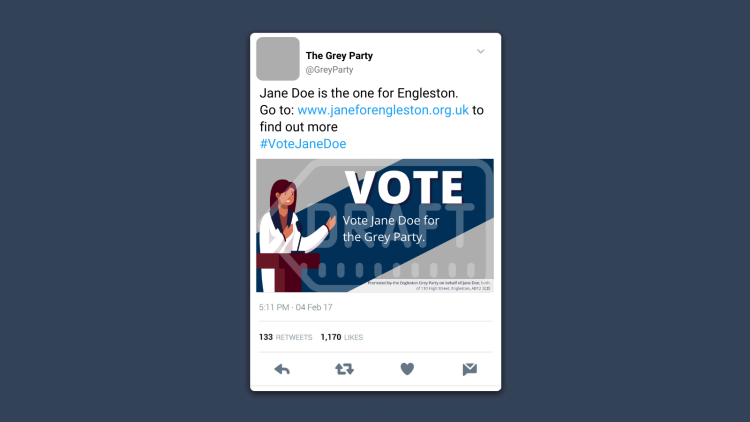
If it is not reasonably practicable to include the imprint as a part of the material, then the imprint must appear somewhere directly accessible from the material. In practice, this means it can be reached via a direct link, usually one click or equivalent, where both the link and the imprint are easy for a voter to locate.
If the imprint appears somewhere directly accessible from the material, it must be included in such a way that it if the material is shared as it is, the imprint will still be accessible from the shared material.
Eg 2
For example, if the material is a tweet, and the imprint is included in your Twitter bio, then if the material is retweeted, the imprint in your bio will still be accessible from the retweet.
Where 3
This means that you must not delete the imprint from your bio for as long as an imprint is required and the material remains published. If you were to delete the imprint, then it would no longer be accessible if your material is shared.
Similarly, you cannot include your imprint somewhere which would not be accessible by those who can view the material itself.
Eg 3
For example, the imprint cannot be behind a paywall or otherwise protected area of the internet, if that would mean that voters would see the shared material but would not have the necessary permission to view the imprint itself.
Where 4
Beyond these requirements, the original promoter of the material is not liable for any imprint offences that are due to the material being shared by other people later on. The liability is on the people republishing the material – see Sharing and republishing digital material.
If the imprint is included somewhere directly accessible from the material, it must be clear that the imprint relates to the material. For example, it would not be acceptable to publish a list of different imprints in one location, directly accessible from lots of different material, without it being clear which imprint relates to which material.
The next sections give some detailed guidance on particular types or categories of digital material, and on what is typically reasonably practicable.
Social media
Usually, the material on social media will be the whole social media post. You must include the imprint in the post itself, unless it is not reasonably practicable.
Eg 1
For example, for paid adverts on Facebook, it will usually be reasonably practicable to include the imprint as a part of the material – you can either include the imprint in the video or image content, or in the surrounding text.
Social media 2
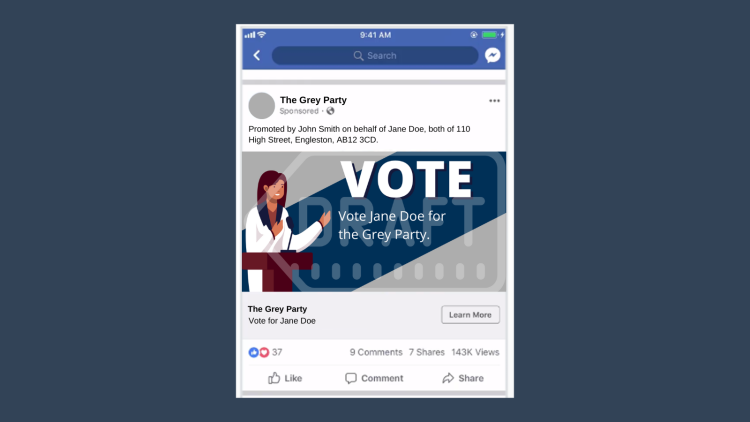
On some digital platforms, the design of the platform, such as there being a character limit on posts, may mean that it is not reasonably practicable to include the imprint as a part of the post. In this case, you must display a legible imprint somewhere directly accessible from the post. The imprint must be directly accessible from the post no matter what device is used. There are a number of different ways that you can do this.
Eg 2
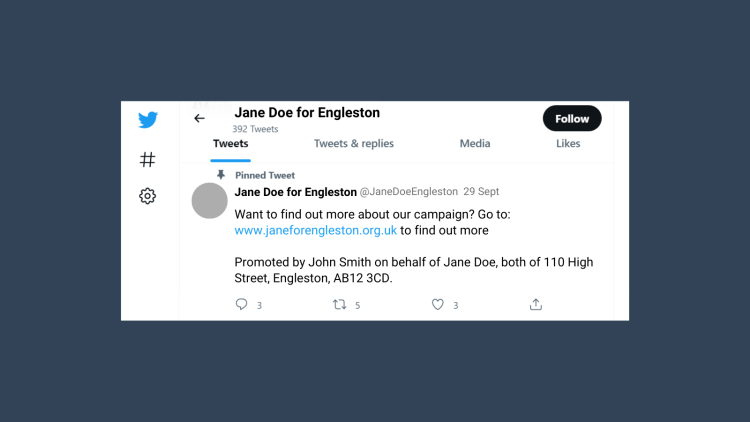
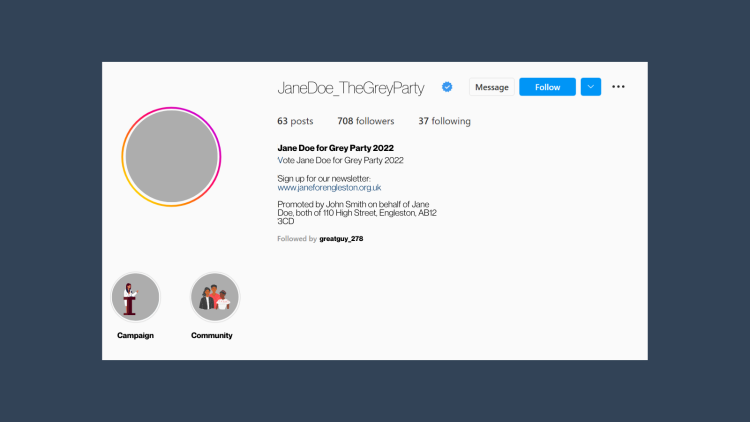
For example, on X, it may often not be reasonably practicable to include the imprint in the post itself because of a character limit. If this is the case, your imprint can be included on your profile, for example underneath your name, or as a pinned post or tweet. Alternatively the imprint can be included somewhere else that you directly link to from your post, for example on your own website.
pinned post
insta
Social media 3
Usually the ‘About’ section of a profile on a digital platform is not directly accessible from a post, because the hyperlink to the profile does not directly take you to that section. In this case, the ‘About’ section will only be directly accessible from a post if you add your own direct link to the ‘About’ section into the post.
If material requires an imprint, you must ensure it is published on a platform that enables you either to include the imprint as part of the material or, if not reasonably practicable, somewhere directly accessible from the material. If a platform has such limited functionality that you cannot do either, then material that requires an imprint must not be published on that platform.
If you publish material that requires an imprint on a platform that has limited functionality, you must include the imprint no matter what the limitations of that platform are. For example, TikTok has an 80-character bio, you cannot include links in a caption, and pinned posts are not available to all users. The best way to avoid these limitations is to include the imprint within the content of your TikTok video itself.
Videos, images and cartoons
A video or image can still be required to display an imprint even if it contains no text.
If your material is a video or image, it will usually be reasonably practicable to include the imprint in the video or image, especially if you have created it yourself. If this is not reasonably practicable, for example if the material is a very small image, you must include the imprint somewhere directly accessible from it.
If your material is a social media post which contains a video or image, then it will usually be reasonably practicable to include the imprint as a part of the post. Where it is reasonably practicable to include the imprint as part of the post, the best way to do this is to include it in the content of the video or image itself.
This is because if it is shared, the imprint is more likely to remain a part of the material. This means that voters will see the original imprint as it is shared, which provides the most effective transparency. It is also less likely that people sharing the material will be required to include their own imprint when they share it. Further detail is included in the section Sharing and republishing digital material.
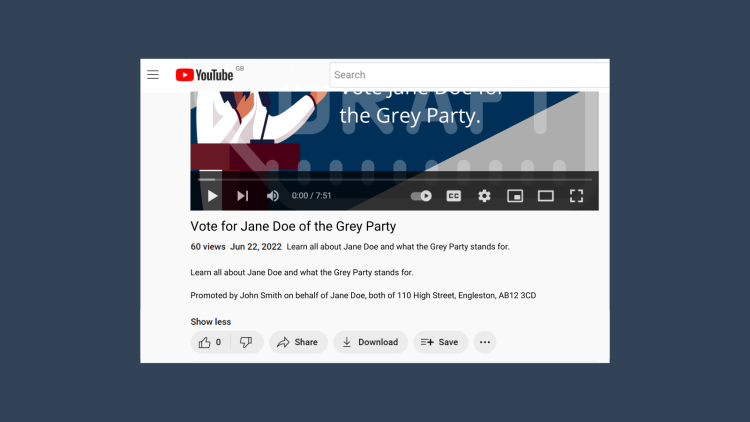
Alternatively, you can include the imprint somewhere else in the post. For example when uploading a video to YouTube, you can include the imprint in the video’s description.
Youtube video digital imprint example
Gwefannau
Os mai gwefan neu dudalen we yw'r deunydd digidol, bydd fel arfer yn rhesymol ymarferol i gynnwys yr argraffnod ar y dudalen we berthnasol. Er enghraifft, gellid ei arddangos yn y troedyn.

Os mai dim ond rhan o'r dudalen we yw'r deunydd, er enghraifft, postiad cyfryngau cymdeithasol sydd wedi'i fewnblannu yn y dudalen, yna rhaid i'r argraffnod gael ei gynnwys fel rhan o'r deunydd os bydd hynny'n rhesymol ymarferol.
Os nad yw'n rhesymol ymarferol, yna gall ymddangos rywle sy'n uniongyrchol hygyrch o'r deunydd – er enghraifft, rhywle arall ar yr un dudalen we, megis y troedyn, neu rywle sydd wedi'i gysylltu â'r deunydd drwy hyperddolen.
eg
Er enghraifft, os mai hysbyseb mewn chwiliad Google yw eich deunydd, efallai na fydd cyfyngiad nodau'r disgrifiad yn ddigon i gynnwys y wybodaeth sydd ei hangen yn yr argraffnod ar y deunydd ei hun. Yn yr achos hwn, gallwch gynnwys yr argraffnod rywle sy'n uniongyrchol hygyrch o'r hysbyseb chwiliad Google, megis y dudalen y mae'r hysbyseb yn arwain ati.
Deunydd sain
Ar ddeunydd sy'n ddeunydd sain yn unig, rhaid i'r argraffnod gael ei gynnwys fel rhan o'r deunydd. Er enghraifft, gallech gynnwys rhywun yn darllen yr argraffnod yn uchel ar y diwedd.
Rhaid i'r argraffnod fod yn glywadwy.
Rhaid i'r argraffnod gael ei ddarllen ar gyflymder lle gellir ei glywed a'i ddeall.
Am ba hyd y mae angen argraffnod ar ddeunydd?
Ym mhob achos, rhaid i'r deunydd digidol gynnwys argraffnod am gyhyd ag y bydd:
- yr argraffnod yn ofynnol yn ôl y gyfraith
- y deunydd wedi'i gyhoeddi o hyd
Bydd deunydd wedi'i gyhoeddi o hyd cyhyd ag y bydd ar gael i'r cyhoedd neu ran o'r cyhoedd. Er enghraifft, os bydd postiad ar gael ar eich sianeli cyfryngau cymdeithasol o hyd, yna bydd wedi'i gyhoeddi o hyd.
Deunydd organig
Ar gyfer deunydd organig, mae'r argraffnod yn ofynnol ar ddeunydd a gyhoeddir gan endid perthnasol am gyhyd ag y bydd y deunydd a gyhoeddir yn dal i fod yn unrhyw un o'r canlynol:
- deunydd etholiad
- deunydd refferendwm
- deunydd deiseb adalw
Am fod y mathau hyn o ddeunydd oll yn gysylltiedig â digwyddiad etholiadol penodol, mewn llawer o achosion ni fydd yr argraffnod yn ofynnol mwyach ar ôl i'r digwyddiad hwnnw ddod i ben.
Er enghraifft, ni fydd fideo sy'n dweud ‘Pleidleisiwch NA ar 10 Mai’ mewn perthynas â refferendwm sydd ar ddod yn ddeunydd refferendwm mwyach ar ôl 10 Mai pan fydd y refferendwm wedi digwydd.
Hysbysebion y telir amdanynt
Ar gyfer hysbyseb y telir amdani, bydd argraffnod yn ofynnol cyhyd ag y bydd y deunydd yn ddeunydd gwleidyddol.
Bydd pa mor hir y bydd y deunydd yn ddeunydd gwleidyddol o hyd yn dibynnu ar bwy neu beth y gellir ystyried yn rhesymol y bwriedir i'ch deunydd ddylanwadu ar gefnogaeth y cyhoedd o'i blaid neu yn ei erbyn. Os bydd y deunydd yn gysylltiedig â digwyddiad etholiadol neu gylch etholiadol penodol, yna daw i ben yn naturiol. Er enghraifft:
- gallai darpar ymgeisydd benderfynu peidio â sefyll
- bydd ymgeisydd yn rhoi'r gorau i fod yn ymgeisydd ar ôl y diwrnod pleidleisio
- bydd deiliad swydd etholedig yn rhoi'r gorau i fod yn ddeiliad swydd etholedig pan ddaw ei gyfnod i ben
- ni ellir dylanwadu ar gefnogaeth neu wrthwynebiad i ganlyniad penodol mewn refferendwm ar ôl y diwrnod pleidleisio
Ni fydd mor amlwg pryd y daw rhai mathau o ddeunydd gwleidyddol i ben. Er enghraifft, gallai deunydd sy'n hyrwyddo cefnogaeth neu wrthwynebiad i blaid wleidyddol barhau i wneud hynny cyhyd ag y bydd y blaid yn bodoli.
Rhannu ac ailgyhoeddi deunydd
Pan fyddwch yn rhannu deunydd â'r cyhoedd neu ran o'r cyhoedd, gan gynnwys ar y cyfryngau cymdeithasol, bydd yn fath o gyhoeddiad. Yn y ddeddfwriaeth, cyfeirir at hyn fel ‘ailgyhoeddi’. Felly mae'r gyfraith ar argraffnodau hefyd yn gymwys i ddeunydd rydych yn ei rannu – er enghraifft, defnyddio'r swyddogaeth ‘aildrydar’ ar Twitter, y botwm ‘Rhannu’ ar Facebook, y swyddogaeth ‘deuawd’ ar TikTok, neu anfon neges e-bost ymlaen.
Mae hyn hefyd yn gymwys pan fyddwch yn rhannu deunydd a gyhoeddwyd gyntaf cyn i'r gyfraith ar argraffnodau digidol ddod i rym.
Fodd bynnag, os byddwch yn rhannu deunydd sydd eisoes wedi cael ei gyhoeddi ag argraffnod cywir ac nad ydych yn newid y deunydd yn sylweddol, ni fydd angen i chi gynnwys argraffnod newydd gyda'ch manylion eich hun. Bydd yr argraffnod gwreiddiol yn ddigonol. Yn y canllawiau hyn, rydym yn cyfeirio at hyn fel yr ‘esemptiad rhannu’.
Mae newid y deunydd yn sylweddol yn cynnwys:
- ei newid mewn modd sy'n newid ystyr y deunydd
- tynnu'r argraffnod (os oedd yn ymddangos yn wreiddiol fel rhan o'r deunydd)
- ei rannu mewn modd sy'n golygu nad yw'r argraffnod yn hygyrch o'r deunydd mwyach (os oedd yn ymddangos yn wreiddiol rywle a oedd yn uniongyrchol hygyrch o'r deunydd)
Os byddwch yn rhannu deunydd digidol sydd wedi'i gyhoeddi eisoes, ond
- rydych yn newid y deunydd hwnnw yn sylweddol, a
- bod angen argraffnod arno ar ei ffurf newydd o hyd
rhaid i chi gynnwys eich argraffnod eich hun, hyd yn oed os oedd gan y deunydd gwreiddiol argraffnod. Os na fyddwch yn gwneud hynny, gallech fod yn cyflawni trosedd.
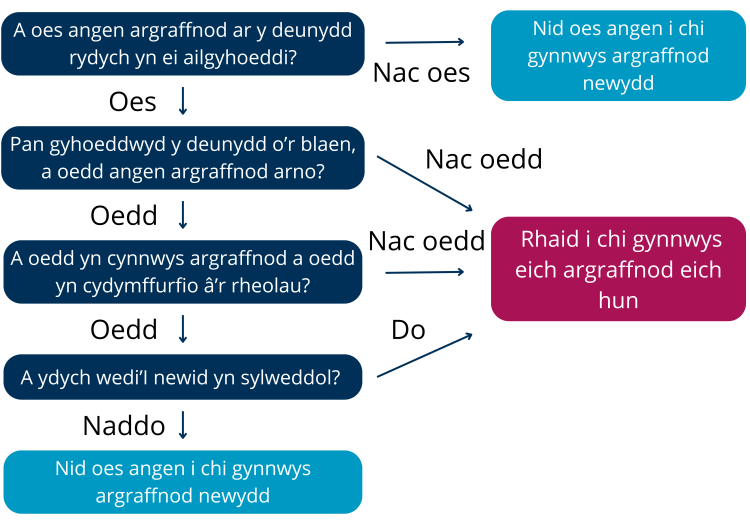
Pan gaiff deunydd ei ailgyhoeddi, y sawl sy'n ailgyhoeddi'r deunydd (ac unrhyw un arall y mae'n ei ailgyhoeddi ar ei ran) fydd yn gyfrifol am gynnwys argraffnod
Ni fydd y ddyletswydd hon ar hyrwyddwr y deunydd gwreiddiol sydd nawr yn cael ei ailgyhoeddi. Dim ond dyletswydd am sicrhau bod modd rhannu'r deunydd gwreiddiol heb golli'r un o'r canlynol sydd gan hyrwyddwr y deunydd gwreiddiol:
- yr argraffnod (os yw wedi'i gynnwys fel rhan o'r deunydd)
- mynediad at yr argraffnod (os yw wedi'i gynnwys rywle sy'n uniongyrchol hygyrch o'r deunydd)
Ym mhob achos, ond yn enwedig os bydd hyrwyddwr yn annog pobl i rannu ei ddeunydd, mae'n arfer dda cynnwys yr argraffnod rywle lle caiff ei gadw hawsaf os caiff y deunydd ei rannu. Os yw'r postiad yn cynnwys delwedd neu fideo, bydd hyn fel arfer yng nghynnwys y ddelwedd neu'r fideo ei hun.
Os ydych yn aelod o'r cyhoedd sy'n rhannu deunydd, ni fydd angen i chi gynnwys argraffnod fel arfer. Mae hyn am nad oes angen i chi gynnwys argraffnod gydag unrhyw ddeunydd organig os nad ydych yn endid perthnasol ac nid ydych yn cyhoeddi ar ran un.
Cyfrifoldebau ar gyfer gorfodi'r drefn
Mae'r Ddeddf Etholiadau yn darparu ar gyfer gorfodi'r drefn ynghylch argraffnodau digidol drwy drosedd o dan adran 48(1) lle na chaiff argraffnod ei gynnwys pan fo angen.
Mae p'un ai'r heddlu neu'r Comisiwn Etholiadol sy'n gyfrifol yn y lle cyntaf yn dibynnu ar ddiben y deunydd dan sylw, fel y nodir yn adran 50. Pan fo ansicrwydd mewn achos penodol o ran pa gorff sy'n gyfrifol am orfodi, caiff y mater ei ddatrys rhwng y cyrff gorfodi fesul achos.
Deunydd gwleidyddol (hysbysebion y telir amdanynt) a deunydd etholiad (deunydd organig)
Yr heddlu fydd yn sicrhau cydymffurfiaeth o ran deunydd sy'n ymwneud â'r canlynol:
- ymgeisydd penodol
- darpar ymgeisydd penodol
- deiliad swydd etholedig penodol
Y Comisiwn Etholiadol fydd yn sicrhau cydymffurfiaeth o ran deunydd sy'n ymwneud â'r canlynol:
- pleidiau gwleidyddol
- categorïau o bleidiau, ymgeiswyr, darpar ymgeiswyr a/neu ddeiliaid swyddi etholedig, gan gynnwys categorïau yn seiliedig ar y canlynol:
- eu cefnogaeth o blaid neu yn erbyn polisïau penodol
- y safbwyntiau penodol sydd ganddynt
- unrhyw reswm arall
Deunydd deiseb adalw
Caiff hyn ei orfodi gan yr heddlu, ar gyfer hysbysebion y telir amdanynt a deunydd organig.
Deunydd sy'n gysylltiedig â refferenda
Y Comisiwn Etholiadol fydd yn sicrhau cydymffurfiaeth o ran unrhyw ddeunydd digidol, ar gyfer hysbysebion y telir amdanynt a deunydd organig, os bydd:
- yn gysylltiedig â refferendwm a gynhelir o dan Ran 7 o Ddeddf Pleidiau Gwleidyddol, Etholiadau a Refferenda 2000 (mae'n refferendwm PPERA)
- yn cael ei gyhoeddi yn ystod cyfnod y refferendwm
Yr heddlu fydd yn sicrhau cydymffurfiaeth o ran unrhyw ddeunydd arall sy'n gysylltiedig â refferendwm.
Hysbysebion y telir amdanynt fydd y deunydd hwn i gyd, gan gynnwys unrhyw hysbyseb y telir amdani sydd naill ai:
- yn gysylltiedig â refferendwm nad yw'n refferendwm PPERA
- yn gysylltiedig â refferendwm sy'n refferendwm PPERA, ond sydd wedi'i gyhoeddi cyn cyfnod y refferendwm
Defnyddio pwerau
Mae'r Ddeddf Etholiadau'n creu dau bŵer newydd mewn perthynas â gorfodi'r drefn.
Defnyddio pwerau o dan Atodlen 12 i Ddeddf Etholiadau 2022 – cael gwybodaeth
Mae gan yr heddlu a'r Comisiwn Etholiadol bwerau o dan Atodlen 12 i'r Ddeddf i gael dau fath gwahanol o wybodaeth.
Mae pŵer i roi hysbysiad ysgrifenedig i unrhyw berson sy'n ei gwneud yn ofynnol i'r person ddarparu gwybodaeth a nodir yn yr hysbysiad, sy'n ofynnol yn rhesymol:
- at ddibenion pennu a yw deunydd digidol wedi'i gyhoeddi heb argraffnod pan oedd angen un, neu
- i alluogi'r heddlu neu'r Comisiwn i gysylltu â hyrwyddwr y deunydd neu unrhyw berson arall y cyhoeddwyd y deunydd ar ei ran
Mae gan yr heddlu a'r Comisiwn hefyd y pŵer i roi hysbysiad ysgrifenedig i unrhyw berson sy'n ei gwneud yn ofynnol i'r person ddarparu deunydd electronig a nodir yn yr hysbysiad, sy'n ofynnol yn rhesymol at ddibenion pennu a yw deunydd electronig wedi'i gyhoeddi heb argraffnod pan oedd angen un.
Yn y ddau achos, gall yr heddlu ddewis defnyddio'r pŵer hwn yn hytrach na phwerau presennol i gael gwybodaeth. Gall y Comisiwn arfer y pŵer hwnnw pan fydd yn gymesur ac er budd y cyhoedd i wneud hynny. Ni fydd yr heddlu na'r Comisiwn yn gwneud hynny pan ellir cael gafael ar y wybodaeth honno drwy ddulliau eraill. Ni chaiff unrhyw wybodaeth a geir o dan hysbysiad o'r fath ei defnyddio mewn unrhyw gam gorfodi yn erbyn y person sy'n darparu'r wybodaeth i'r Comisiwn.
Cydymffurfio â hysbysiadau
Pan gaiff y naill neu'r llall o'r pwerau hyn eu harfer gan yr heddlu neu'r Comisiwn, caiff dyddiad cau ar gyfer cydymffurfio ei nodi y bydd yn rhaid cydymffurfio ag ef. Bydd y dyddiad cau yn gymesur, gan ystyried ffeithiau'r sefyllfa benodol, gan gynnwys ar faint o fyrder y mae angen cael gafael ar y wybodaeth.
Lle na chydymffurfir â hysbysiad o'r fath, gall yr heddlu neu'r Comisiwn geisio gorchymyn llys yn gofyn am y wybodaeth.
Defnyddio pwerau o dan adran 51 o Ddeddf Etholiadau 2022 – tynnu deunydd i lawr
Mae gan y Comisiwn bŵer o dan adran 51 o'r Ddeddf i'w gwneud yn ofynnol i unrhyw ddeunydd gael ei dynnu i lawr neu i atal mynediad ato ar ôl i'r Comisiwn benderfynu bod trosedd wedi'i chyflawni o dan adran 48(1) mewn perthynas â'r deunydd hwnnw a gosod unrhyw gosb, neu gyflwyno Hysbysiad Atal, neu gytuno ar Ymgymeriad Gorfodi o dan ei bwerau yn Atodlen 19C i Ddeddf Pleidiau Gwleidyddol, Etholiadau a Refferenda 2000.
Wrth benderfynu a ddylai arfer ei bŵer o dan adran 51 o'r Ddeddf, bydd y Comisiwn yn ystyried a fyddai gwneud hynny:
- yn gymesur ac er budd y cyhoedd
- yn unol â'i amcanion gorfodi
- yn helpu i gynnal neu wella tryloywder.
Ni fydd yn arfer y pŵer hwnnw fel arfer, er enghraifft, pan fydd y deunydd eisoes wedi'i dynnu i lawr; mae'r deunydd wedi'i ddiwygio i sicrhau ei fod yn cydymffurfio; neu am unrhyw reswm arall nad yw'n gymesur nac er budd y cyhoedd ei gwneud yn ofynnol iddo gael ei dynnu i lawr.
Mae pŵer tebyg ar gael i lys o dan adran 49(2) o'r Ddeddf, yn dilyn euogfarn ar gyfer trosedd o dan adran 48(1). Nid oes pŵer cyfatebol ar gael i'r heddlu oherwydd dim ond ar ôl canfod trosedd y gellir defnyddio'r pŵer hwn, naill ai gan lys neu'r Comisiwn.
Mae'n drosedd i unrhyw berson sy'n cael hysbysiad i dynnu deunydd i lawr i fethu â chydymffurfio ag ef heb esgus rhesymol.
Termau allweddol
Ymgeisydd
Ymgeisydd yw ymgeisydd mewn etholiad ar gyfer swydd etholedig berthnasol, gan gynnwys person sydd wedi'i gynnwys mewn rhestr o ymgeiswyr a gyflwynwyd mewn cysylltiad ag etholiad o'r fath.
Deunydd digidol
Yn Neddf Etholiadau 2022, cyfeirir at ddeunydd digidol fel ‘deunydd electronig’.
Deunydd digidol yw deunydd sydd ar ffurf electronig sy'n cynnwys:
- testun, delweddau sy'n symud neu ddelweddau llonydd, neu
- iaith lafar neu gerddoriaeth.
Nid yw'n cynnwys deunydd a dderbynnir gan berson ar ffurf galwad ffôn (e.e. i rif ffôn llinell dir) na deunydd a dderbynnir drwy neges destun gan ddefnyddio SMS i rif ffôn.
Deiliad swydd etholedig
Rhywun sydd â swydd etholedig berthnasol yw deiliad swydd etholedig.
Dylid trin deiliad swydd etholedig fel pe bai gan yr unigolyn swydd yn ystod unrhyw gyfnod pan –
- fydd y person wedi'i ethol fel deiliad y swydd, neu y datganwyd y bydd yn dychwelyd fel deiliad y swydd, ond
- nad yw ei gyfnod yn y swydd wedi dechrau eto
Deunydd etholiad
Deunydd etholiad yw deunydd y gellir ystyried yn rhesymol ei fod yn hyrwyddo neu'n sicrhau llwyddiant etholiadol mewn un etholiad perthnasol neu fwy ar gyfer:
- un neu fwy o bleidiau gwleidyddol
- ymgeisydd neu ddarpar ymgeisydd
- pleidiau gwleidyddol, ymgeiswyr, neu ddarpar ymgeiswyr sy'n gysylltiedig oherwydd eu bod yn cefnogi neu'n gwrthwynebu polisïau penodol, neu'n arfer barn benodol
- categorïau eraill o bleidiau, ymgeiswyr neu ddarpar ymgeiswyr nad ydynt yn seiliedig ar bolisïau neu farn – er enghraifft, ymgeiswyr neu ddarpar ymgeiswyr a aeth i ysgol wladol, neu ymgeiswyr annibynnol (nad ydynt yn sefyll ar ran plaid wleidyddol)
- unrhyw gyfuniad o'r uchod
Darpar ymgeisydd
Bydd person yn ddarpar ymgeisydd mewn etholiad ar gyfer swydd etholedig berthnasol os –
- datganwyd bod y person, boed hynny gan y person neu gan rywun ar ei ran, yn ymgeisydd yn yr etholiad (ac nad yw'r datganiad wedi cael ei dynnu'n ôl),
- mai'r etholiad yw'r etholiad nesaf a drefnwyd ar gyfer y swydd, ac
- nid yw hysbysiad yr etholiad wedi cael ei gyhoeddi eto neu, yn achos etholiad ar gyfer swydd aelod o Dŷ'r Cyffredin, nid yw'r gwrit ar gyfer yr etholiad wedi'i chyflwyno eto.
Deunydd organig
Deunydd organig yw unrhyw ddeunydd nad yw'n hysbyseb y telir amdani. Hynny yw, deunydd lle nad yw hyrwyddwr y deunydd, na'r person y cyhoeddwyd y deunydd ar ei ran, wedi talu i'r deunydd gael ei gyhoeddi fel hysbyseb.
Hysbyseb y telir amdani
Hysbyseb y telir amdani yw deunydd lle mae hyrwyddwr y deunydd, neu'r person y cyhoeddwyd y deunydd ar ei ran, wedi talu i'r deunydd gael ei gyhoeddi fel hysbyseb.
At ddibenion y diffiniadau o ‘hysbyseb y telir amdani’ a ‘deunydd organig’, nid yw taliadau'n gyfyngedig i arian yn unig. Gallant hefyd gynnwys buddion mewn nwyddau.
Nid ydynt yn cynnwys taliadau sy'n rhan o gostau cefndir creu, sefydlu, gweithredu na chynnal y deunydd. Mae'n gyfyngedig i daliadau a wneir yn benodol i ddarparwr y gwasanaeth neu'r llwyfan sy'n lletya'r hysbysebion am gyhoeddi'r hysbysebion hynny.
Deunydd gwleidyddol
Deunydd gwleidyddol yw deunydd y gellir ystyried yn rhesymol mai ei unig ddiben neu ei brif ddiben yw dylanwadu ar y cyhoedd, neu unrhyw ran o'r cyhoedd, i gefnogi neu beidio â chefnogi:
- un neu fwy o bleidiau gwleidyddol
- ymgeisydd penodol neu ddarpar ymgeisydd penodol (yn ei rinwedd fel y cyfryw)
- deiliad swydd etholedig penodol (yn ei rinwedd fel y cyfryw)
- pleidiau gwleidyddol, ymgeiswyr, darpar ymgeiswyr neu ddeiliaid swyddi etholedig (yn eu rhinwedd fel y cyfryw) sy'n gysylltiedig oherwydd eu bod yn cefnogi neu'n gwrthwynebu polisïau penodol, neu'n arfer barn benodol
- categorïau eraill o bleidiau, ymgeiswyr, darpar ymgeiswyr neu ddeiliaid swyddi etholedig (yn eu rhinwedd fel y cyfryw) nad ydynt yn seiliedig ar bolisïau neu farn – er enghraifft, ymgeiswyr neu ddarpar ymgeiswyr a aeth i ysgol wladol, neu ASau sydd wedi cael swydd y tu allan i wleidyddiaeth
- cynnal refferendwm, neu ganlyniad penodol refferendwm
- unrhyw gyfuniad o'r uchod
Hyrwyddwr
Yr hyrwyddwr yw'r person sy'n peri i'r deunydd gael ei gyhoeddi.
Cyhoeddi
Ystyr cyhoeddi yw rhyddhau i'r cyhoedd yn gyffredinol, neu unrhyw ran o'r cyhoedd.
Deiseb adalw
Trefn o dan Ddeddf Adalw ASau 2015 yw deiseb adalw lle gall AS presennol gael ei “adalw” gan ei etholwyr yn ystod cyfnod senedd, gan arwain at is-etholiad o bosibl.
Deunydd deiseb adalw
Deunydd deiseb adalw yw deunydd sy'n hyrwyddo neu'n sicrhau llwyddiant neu fethiant deiseb adalw.
Ymgyrchydd deiseb adalw
Ymgyrchydd deiseb adalw yw person sy'n ymgyrchydd achrededig o fewn yr ystyr a geir yn Neddf Adalw ASau 2015 mewn perthynas â deiseb adalw.
Refferenda (hysbysebion y telir amdanynt):
Ystyrir bod hysbyseb y telir amdani yn ddeunydd gwleidyddol os gellir ystyried yn rhesymol mai ei hunig ddiben neu ei phrif ddiben yw dylanwadu ar y cyhoedd, neu unrhyw ran o'r cyhoedd, i gefnogi neu beidio â chefnogi unrhyw refferendwm, sy'n cynnwys y canlynol ond heb fod yn gyfyngedig iddynt:
Key terms2
Refferendwm a gynhelir o dan Reoliadau Awdurdodau Lleol (Cynnal Refferenda) (Cynyddu'r Dreth Gyngor) (Lloegr) 2012.
Refferendwm a gynhelir o dan adran 9MB a 9MC o Ddeddf Llywodraeth Leol 2000.
Refferendwm a gynhelir o dan Reoliadau Awdurdodau Lleol (Refferenda) (Deisebau) (Lloegr) 2011 neu Reoliadau Awdurdodau Lleol (Refferenda) (Deisebau a Chyfarwyddiadau) (Cymru) 2001.
Digwyddiad pleidleisio lleol (math o refferendwm) a gynhelir o dan adran 116 o Ddeddf Llywodraeth Leol 2003.
Refferendwm a gynhelir o dan Reoliadau Cynllunio Cymdogaeth (Refferenda) 2012 (fel y'i diwygiwyd).
Digwyddiad pleidleisio plwyf (math o refferendwm) a gynhelir o dan adran 150 ac Atodlen 12 o Ddeddf Llywodraeth Leol 1972.
Refferendwm a gynhelir o dan Ran 7 o Ddeddf Pleidiau Gwleidyddol, Etholiadau a Refferenda 2000, gan gynnwys
- refferendwm ledled y DU
- refferendwm a gynhelir yng Nghymru, yr Alban, Lloegr neu Ogledd Iwerddon neu mewn mwy nag un o'r rhain
Ond heb gynnwys refferendwm Senedd Cymru.
Refferendwm a gynhelir o dan Adran 64 o Ddeddf Llywodraeth Leol 2006.
Key terms 3
I'r gwrthwyneb, dim ond os yw deunydd yn ymwneud â refferendwm PPERA yn gyfan gwbl neu'n bennaf yr ystyrir bod deunydd organig yn ddeunydd refferendwm.
Deunydd refferendwm (deunydd organig)
Deunydd refferendwm yw deunydd sy'n gysylltiedig yn gyfan gwbl neu'n bennaf â refferendwm o dan Ran 7 o Ddeddf Pleidiau Gwleidyddol, Etholiadau a Refferenda 2000, ac a gyhoeddir yn ystod cyfnod y refferendwm hwnnw.
Cyfnod y refferendwm
Y cyfnod cyn refferendwm PPERA lle mae cyfyngiadau penodol ar waith, o dan adran 102 o Ddeddf Pleidiau Gwleidyddol, Etholiadau a Refferenda 2000
Ymgyrchydd cofrestredig nad yw'n blaid
Ymgyrchydd cofrestredig nad yw'n blaid yw ymgyrchydd a gaiff ei gydnabod gan y Comisiwn Etholiadol o dan Ran 6 o Ddeddf Pleidiau Gwleidyddol, Etholiadau a Refferenda 2000. Yn y ddeddfwriaeth, cyfeirir at ymgyrchwyr cofrestredig nad ydynt yn bleidiau fel ‘trydydd partïon cydnabyddedig’.
Plaid gofrestredig
Plaid gofrestredig yw plaid wleidyddol sydd wedi'i chofrestru gan y Comisiwn Etholiadol o dan Ran 2 o Ddeddf Pleidiau Gwleidyddol, Etholiadau a Refferenda 2000.
Ymgyrchydd refferendwm cofrestredig
Ymgyrchydd refferendwm cofrestredig yw unigolyn neu sefydliad sy'n gyfranogwr a ganiateir o fewn yr ystyr a geir yn Rhan 7 o Ddeddf Pleidiau Gwleidyddol, Etholiadau a Refferenda 2000, mewn perthynas â refferenda y mae'r Rhan honno yn gymwys iddi. Yn y ddeddfwriaeth, cyfeirir at ymgyrchwyr refferendwm cofrestredig fel ‘cyfranogwyr a ganiateir’.
Etholiad perthnasol
Ystyr “Etholiad perthnasol” yw unrhyw etholiad a resrir yn adran 45(9) o Ddeddf Etholiadau 2022, fel y’i diwygir o bryd i’w gilydd, gan gynnwys:
- etholiadau cyffredinol Senedd y DU
- etholiadau Senedd yr Alban
- etholiadau Senedd Cymru
- etholiad Cynulliad Gogledd Iwerddon
- etholiadau Comisiynwyr yr Heddlu a throseddu
- etholiadau lleol, gan gynnwys etholiadau maerol, etholiadau Awdurdod Llundain Fwyaf ac etholiadau plwyf, tref a chymuned
Swydd etholedig berthnasol
Ystyr “swydd etholedig berthnasol” yw unrhyw swydd a resrir yn adran 37(1) o Ddeddf Etholiadau 2022, fel y’i diwygir o bryd i’w gilydd, gan gynnwys y rheiny y’u diffinnir yno yn “swydd etholedig berthnasol yn yr Alban”.
Mae hyn yn cynnwys:
- aelod o Dŷ'r Cyffredin
- aelod o Senedd yr Alban
- aelod o Senedd Cymruaelod o Gynulliad Gogledd Iwerddon
- Comisiynydd yr Heddlu a Throseddu
- maer etholedig
- aelod o Gynulliad Llundain
- cynghorydd
- aelod o Gorfforaeth Dinas Llundain
Endid perthnasol
Endid perthnasol yw un o'r mathau o unigolyn neu sefydliad y gall fod yn ofynnol iddo gynnwys argraffnod ar ddeunydd organig.
Yr endidau perthnasol yw:
- plaid gofrestredig
- ymgyrchydd cofrestredig nad yw'n blaid
- ymgeisydd neu ddarpar ymgeisydd
- deiliad swydd etholedig
- ymgyrchydd refferendwm cofrestredig
- ymgyrchydd deiseb adalw cofrestredig