Updates to our guidance
| Date of update | Description of change |
|---|---|
| June 2025 | Since the last Scottish Parliamentary election, the guidance has been rewritten into HTML. As part of the rewrite, we made the following three notable updates:
|
About this guidance
Under the Political Parties, Elections and Referendums Act 2000 (PPERA), there are laws on fundraising and spending that political parties must follow in the run-up to certain elections.
This guidance provides information on the regulated period, spending limits, campaign spending, reporting requirements and deadlines for the Scottish Parliamentary election on 7 May 2026.
Different controls apply to constituency and independent regional candidates. We issue separate guidance for those candidates and their agents.
When parties issue election material it must contain details known as an imprint. We publish separate guidance on imprints.
Terms and expressions we use
In this guidance, we use ‘must’ when we refer to a specific requirement. We use ‘should’ for items we consider to be minimum good practice, but which are not legal requirements.
We use ‘you’ or ‘the responsible person’ to refer to the person who is responsible for campaign spending. This will be the registered campaigns officer if one has been appointed, or the registered treasurer if not.
Translations and other formats
For information on obtaining this publication in another language or in Braille, please contact the Electoral Commission:
Tel: 0333 103 1928
Email: [email protected]
Our approach to enforcement
We aim to regulate political funding and spending in a way that is effective, proportionate and fair. We are committed to providing those we regulate with a clear understanding of their legal obligations through our guidance documents and advice service. If you are unsure of how the law applies to you, please contact us for advice. We are happy to help, so please get in touch.
We use advice and guidance proactively to secure compliance. And we take enforcement action, using our investigatory powers and sanctions, where it is necessary and proportionate to do so to meet our enforcement aims and objectives.
If you do not comply with the law, you or your organisation may be subject to civil or criminal sanctions. You can find more information about our approach to enforcement at electoralcommission.org.uk/political-registration-and-regulation/our-enforcement-work
The regulated period
Campaign spending is what your party spends on certain activities to promote the party or criticise other parties during a particular period in the run-up to the election.
This period is called the ‘regulated period’. The regulated period is the time when the spending limits and rules apply.
The regulated period for the 2026 Scottish Parliamentary election begins on 7 January 2026, and runs to polling day on 7 May 2026.1
If your party is standing candidates on a regional list, spending on activities to promote your party list candidates will also be party campaign spending.
Any spending you incur which promotes your party or any of its candidates in the regulated period is included, unless that spending was reported in candidate return or a recall petition return.
This includes spending promoting your party in the Scottish Parliamentary election, but also spending promoting your party in any other elections in Scotland during the regulated period.
- 1. Schedule 9, paragraph 5(3), Political Parties, Elections and Referendums Act 2000 (PPERA) ↩ Back to content at footnote 1
The spending limit
The maximum amount that you can spend on campaigning during the regulated period is based on how many constituencies and regions your party is contesting in the election.1
There are 73 constituencies in Scotland and 8 regions. There are 7 seats in each of the 8 regions, making a total of 56 regional seats. A party can field up to 12 candidates per region.
Your spending limit is £12,000 for each constituency your party contests, plus £80,000 for each region your party contests.
The regional spending limit applies even if you do not field a full list of candidates in the region.
The spending limit is a national limit, which means you do not have to attribute your spending between constituencies and regions.
If your party is contesting every constituency and region, the total spending limit will be £1,516,000:
| £12,000 x 73 constituencies | £876,000 |
| £80,000 x 8 regions | £640,000 |
| Total | £1,516,000 |
eg
You should calculate your party spending limit by working out how many constituencies and regions that your party will be contesting in the Scottish Parliamentary election, and multiplying these numbers by the spending limit for the constituency and/or region.
In this example, the party is contesting 25 constituencies and 3 regions.
| Number of constituencies and/or regions contesting | Calculation | Total £ |
|---|---|---|
| 25 constituencies | 25 x £12,000 | £300,000 |
| 3 regions | 3 x £80,000 | £240,000 |
| Total spending limit | £540,000 |
Parties standing joint candidates with another party
For more information on the 73 constituencies and 8 regions, please see the Boundaries Commission for Scotland’s maps of constituencies and regions for the Scottish Parliamentary election in 2026:
Second Review of Scottish Parliament Boundaries | Scottish Boundary Commission
Parties standing joint candidates with another party
Some candidates stand under a joint description, meaning they can stand for two or more registered political parties at once. These candidates are called 'joint candidates'.
If your party is standing a joint candidate, the full £12,000 for their constituency is not added when calculating your spending limit. Instead, you add £12,000 divided by the number of parties that the candidate is standing for.2
For example, if the candidate is standing under a joint description shared with your party and one other, then you and the other party both have £6,000 from that constituency.
Joint description example
For example:
Your party is standing 10 candidates under a joint description with one other party.
Your party is also standing candidates in 25 other constituencies under your party name only, and in 4 regions.
Spending limit calculation:
(10 x £12,000/2) + (25 x £12,000) + (4 x £80,000) = £680,000.
- 1. Sch 9 para 5(2) PPERA ↩ Back to content at footnote 1
- 2. Sch 9 paras 5(2A) & 5(2B) PPERA ↩ Back to content at footnote 2
Managing campaign spending
Who is responsible for party campaign spending?
A party’s registered treasurer is usually responsible for making sure that the party follows the law on campaign spending.1 However, if a party has registered a campaigns officer, this person is responsible for campaign spending instead.2
You can appoint deputies to help with some of your responsibilities. You can do this on PEF Online or by using Form RP5.
Authorising and paying campaign expenses
Only the responsible person registered with us, their deputies, and people authorised in writing by the responsible person can incur and pay for party campaign spending.3
By ‘incur’ we mean making a legal commitment to spend the money.
For example, someone may be authorised to spend money on particular items, or up to a particular amount.
You incur election spending when you enter a transaction with a supplier and become liable to pay for the item, goods or service they have provided to you. For example, you hire a printing company to print leaflets, or you sign a contract to rent an office.
Payments are often incurred and paid at the same time. For example, if you buy something online or in a shop.
Sometimes spending is incurred before it is paid. For example, if you engage an events company to run your manifesto launch, the spending is incurred when you engage their services. The payment is made later, once they invoice you after the event.
Spending by or on behalf of the party promoting regional party list candidates will count as party campaign spending. Therefore, these expenses must be authorised by the responsible person.
These laws are in place to make sure that you can be in control of your party spending and accurately record and report it. It is important you have sufficient processes in place to allow you to keep track of spending.
You should make sure that your volunteers and campaigners know who can and cannot incur and pay costs.
Parties with accounting units
Your party may have accounting units registered with us, such as constituency parties. Although they report their accounts separately, accounting units remain part of the party.
Any spending by or on behalf of an accounting unit is spending by the party. It must therefore be incurred and paid by someone authorised by the responsible person, and must appear in the spending return along with receipts for any items of over £200.
Any transfer between accounting units, or between an accounting unit and the central party, is an internal transfer. This includes for example any gifts, loans or sales.
This means it is not possible for an accounting unit to donate to the central party. Instead, this would be the party moving around its assets internally.
Similarly, if an accounting unit provides or transfers something to the central party for use in the campaign, this is not notional spending. This is because, since the accounting unit is a part of the party, it cannot provide or transfer anything that the party does not already own.
In this situation, the central party would be using something it already owned. Therefore if it was the first time the party had used it, the spending would count as party spending in this election – see Use of items.
Paper eg
For example, an accounting unit has a large surplus of paper which it gives to the central party to use for printing leaflets. Since the paper was already owned by the party, this is not a donation. The spending on the paper used must appear in the party return, and since it is worth more than £200, the invoice for the accounting unit’s purchase of the paper must also be included.
- 1. Section 24(4) Political Parties, Elections and Referendums Act 2000 (PPERA) ↩ Back to content at footnote 1
- 2. s25 PPERA ↩ Back to content at footnote 2
- 3. s75 and s76 PPERA ↩ Back to content at footnote 3
Personal expenses for party list candidates
You must appoint an election agent for each region the party stands candidates in.1 The election agent is responsible for making payments for some personal expenses incurred by the regional party list candidates.
Personal expenses include the reasonable travel and living expenses (such as hotel costs) of the regional party list candidate.
Once they are officially a candidate, a regional party list candidate can only pay for personal expenses up to a cost of £900. The election agent is responsible for making payments for personal expenses for regional party list candidates over £900.2
Personal expenses also include expenses relating to the party list candidate’s disability. However, the candidate can pay any amount of these expenses.
More detail can be found in Personal expenses in the candidate guidance.
- 1. Article 32(1)(c) The Scottish Parliament (Elections etc.) Order 2015 (SPEO) ↩ Back to content at footnote 1
- 2. A39(1) SPEO ↩ Back to content at footnote 2
What activities count as spending?
Campaign spending is what the party spends on certain activities to promote itself or its candidates, or criticise other parties, during the regulated period.1
If your party is standing candidates on a regional list, party campaign spending will also include spending on activities to promote the party list candidates.
Spending promoting a particular constituency candidate will be covered by the separate candidate spending laws – please see Party spending and candidate spending below.
Campaign spending includes any items or services used during the regulated period, including:
- items or services bought before the regulated period begins, but used during it
- items or services given to the party free of charge or at a non-commercial discount of more than 10% and then used in your campaign (see Notional spending).
All party spending must be reported to the Electoral Commission after the election.2
Activities included in campaign spending are:3
- party political broadcasts, if your party is entitled to one
- party advertising of any kind. For example, street banners, websites or YouTube videos
- unsolicited material sent to voters about the party. For example, letters or leaflets you send that are not in response to specific queries
- the manifesto and other documents setting out your party’s policies
- market research or other methods of finding out which party people intend to vote for (where the research involves identified candidates however, it may be candidate spending)
- party press conferences or other dealings with the media
- party rallies and events, including the cost of people’s attendance, and any goods, services or facilities provided
- transport in connection with promoting or publicising your party
Which costs are included?
You must include any relevant costs associated with each activity. For example, if you are producing leaflets or advertising, you must include the design and distribution costs. You must also include overheads or administrative costs which are associated with each activity.
All costs must include VAT, even if you can recover VAT payments.
Guidance on the relevant costs associated with each activity is included in the following sections. It is not an exhaustive list. If you have queries about specific overhead costs, please contact us for advice.
- 1. s72 & Sch 8, part 1 PPERA ↩ Back to content at footnote 1
- 2. s80 PPERA ↩ Back to content at footnote 2
- 3. Sch 8, para 1 PPERA ↩ Back to content at footnote 3
General overheads and associated costs
Where relevant overhead and associated costs are incurred, the amount that counts as campaign expenditure is the portion that reasonably reflects usage during the campaign. It is that portion which must be included in the return and counts towards the spending limit.1
This applies to items such as:
- office space
- business rates
- electricity bills
- provision of phone lines and internet access
- provision of office equipment of any kind
The proportion that reasonably reflects usage is generally the amount that is incurred over and above the usual costs in a given period.
Eg
For example, a party pays a standard amount per month for electricity. In the period in the lead up to the election it incurs an extra amount above what it would ordinarily pay. The extra amount is the amount that must be reported in the return.
Broadband eg
For example, a party has a contract for broadband of a fixed amount every month. Although the party uses the broadband during the regulated period, the price remains the same as usual. Therefore no spending needs to reported in the return.
Which costs are not included?
VAT
If you have paid VAT on an item, you must include this when reporting the costs of the item in your return. You must still include VAT even if it can be reclaimed as a business expense.
Invoices for payments made to companies based overseas may not always include VAT. If you have paid VAT, you should include this as part of the cost of the item when reporting, even if VAT is not included on the invoice.
For example, you pay for digital material to be published as adverts on a social media platform based overseas. You paid VAT on the adverts, but your invoice does not include VAT. You must still include the VAT you paid when reporting the costs of the adverts in your return.
Which costs are not included?
The costs of water, gas, council tax and childcare do not need to be reported. They are not considered sufficiently closely connected to regulated campaign activities.
- 1. s79 PPERA ↩ Back to content at footnote 1
Party political broadcasts
If you are entitled to party political broadcasts, you must include the production costs as campaign spending. You do not need to include the value of the airtime.1
You must include the cost of use, or hire, of any:
- agency, individual or organisation
- services provided by any agency, individual or organisation
- premises or facilities
- equipment
to prepare, produce or facilitate the production of the content or to broadcast the content.
Overheads and associated costs
It includes the cost of any software of any kind for use on any device for the design and production of material in-house.
eg
For example, a licensing fee for a software application for use in designing broadcast content.
Party political broadcasts 2
It includes the cost of purchase and use of any equipment for the preparation, production, facilitation of production or broadcast of the content.
It includes a relevant proportion of the cost of:
- office accommodation
- business rates
- electricity
- phone rental and internet access
associated with the preparation, production, facilitation of production and/or broadcast of the content.
It includes the cost of food and/or accommodation for any individual who provides services in connection with the broadcast for the party where that is paid for by the party or reimbursed by the party.
- 1. Schedule 8, Part 1, paragraph 1(1) Political Parties, Elections and Referendums Act 2000 (PPERA) ↩ Back to content at footnote 1
Advertising
This includes the cost of use, or hire, of any:
- agency, individual or organisation
- services provided by any agency, individual or organisation
- premises or facilities
- equipment
that is used to:
- prepare, produce or facilitate the production of advertising material
- distribute or facilitate the dissemination of that advertising material via any means, including any cost attributable to increasing the visibility of content by any means.
eg1
For example, the hire of a photographer and premises to produce images for use in advertising material.
eg2
For example, the purchase of a more prominent position on a page within a search engine.
Advertising 2
It includes the cost of any software, of any kind, for use on any device to:
- design and produce advertising material in-house
- disseminate or facilitate dissemination of advertising material
whether that material is distributed digitally, electronically or via other means.
eg 3
For example, a licensing fee for a software application for use on a device.
Ads 3
It includes the cost of preparing, producing or facilitating the production of advertising material for:
- downloading and use by others
- posting on and promoting the party via any kind of social media channel or platform
eg 4
For example, the costs of producing advertising material promoting the party that is posted to a page on a social media channel encouraging followers to share it.
Ads 4
It includes the cost of accessing, purchasing, developing and maintaining any digital or other network which:
- facilitates distribution or dissemination of advertising material by any means
- promotes or increases the visibility of advertising material by any means
eg 5
For example, the purchase of digital identities used to make material appear as if it has been seen and approved by a high number of users on a social media platform.
Ads 5
It includes the costs of:
- hosting and maintaining a website or other electronic/digital material that promotes the party
- designing and building the website
- a portion of any website or material that is set up to obtain funds for the party but also promotes the party during the regulated period
It includes the cost of any rights or licensing fee for any image used in producing advertising material.
It includes the cost of purchase and use of any equipment in connection with:
- preparation, production or facilitating the production of the advertising material
- dissemination of the advertising material by distribution or otherwise
It includes the cost of:
- paper or any other medium on which advertising material is printed
- physically displaying advertising in any location, for example cable ties or glue for putting up posters
It includes the cost of purchase, hire or use of:
- photocopying equipment
- printing equipment
for use in printing advertising material.
It includes a relevant proportion of the cost of:
- office accommodation
- business rates
- electricity
- phone rental and internet access
in connection with:
- preparation, production or facilitating the production of the advertising material
- dissemination of the advertising material by distribution or otherwise
It includes the cost of food and/or accommodation for any individual who provides services in connection with advertising material for the party where that is paid for or reimbursed by the party.
Downloadable material
If you put material on a website for people to print off for their personal use, such as window posters or petition forms, the design and website costs count as campaign spending. You do not need to count people’s print costs against your spending limit, as the costs will be very low.
If the material could be printed and distributed to voters – for instance a leaflet – you will need to make it clear how you expect people to use it. If you authorise wider use of the material, the production costs may count as campaign spending whoever does the printing.
Unsolicited material addressed to voters
Costs associated with obtaining information and targeting or identifying voters, including database costs
This includes the cost of accessing, obtaining, purchasing, developing or maintaining:
- IT software or contact databases
- any information, by whatever means
that is used to facilitate the sending of unsolicited material to voters.
eg 1
For example, the purchase of email addresses.
unsol 2
It includes the cost of accessing, obtaining or developing data sets, including data analytics to target voters by whatever means, including the cost of software, or agencies, organisations or others that identify groups of voters, by whatever means.
eg2
For example, the cost of any agency paid to analyse social media content to facilitate targeting of voters across electoral areas and the cost of modelling by any agency based on that analysis.
unsol 3
It includes the cost of any services to identify voters that are purchased, developed or provided before the regulated period, but are used to target voters during the regulated period.
Where information or access to information is obtained from a third party, the commercial cost of obtaining that information from the third party is included.
Costs associated with preparing, producing or distributing unsolicited material to voters, including via digital means
This includes the cost of use, or hire, of any:
- agency, individual or organisation
- services provided by any agency, individual or organisation
- premises or facilities
- equipment
that is used to:
- prepare, produce or facilitate the production of the unsolicited material
- disseminate by distribution or otherwise the unsolicited material, including any cost attributable to increasing the visibility of material via any means.
It includes the cost of delivering material by any means including electronic means or the physical distribution of the material, for example the cost of envelopes and stamps or the purchase of a system for sending emails.
It includes the cost of accessing, developing and maintaining any digital or other network which promotes or increases the visibility of unsolicited material on any platform.
eg3
For example, payment to developer to create an app that facilitates targeting of the party’s material on a social media channel.
unsol 4
It includes the cost of oversight and maintenance of all social media, digital or other forms of distribution of unsolicited material. This includes the maintenance of all social media accounts, including if they are maintained by another entity/individual.
Election address
Each party’s nominating officer is entitled to free postage to deliver two election addresses to voters in the constituency. The address must only contain matters relating to the election.1
The costs of producing these election addresses must be reported as party spending.
Other costs that are included
It includes the cost of any rights or licensing fee for any image used in producing unsolicited material.
It includes the cost of paper or any other medium on which unsolicited material is printed.
It includes the cost of purchase and use of any equipment in connection with:
- preparation, production or facilitating the production of the unsolicited material
- dissemination by distribution or otherwise of the unsolicited material
It includes the cost of purchase, hire or use of:
- photocopying equipment
- printing equipment
for use in printing unsolicited material.
It includes a relevant proportion of the cost of:
- office accommodation
- business rates
- electricity
- phone rental and internet access
associated with the preparation, production, dissemination and distribution of unsolicited material.
It includes the cost of food and/or accommodation for any individual who provides services in connection with unsolicited material for the party where that is paid for by the party or reimbursed by the party.
Costs that are not included
It does not include any cost associated with the obtaining of data as permitted under any statute or regulation.
eg4
For example, political parties are entitled to a copy of the electoral register via regulation 105 of the Representation of the People (Scotland) Regulations 2001. No notional spending needs to be accounted for with regard to use of such a register.
- 1. a61 SPEO ↩ Back to content at footnote 1
Your manifesto and other documents setting out your party’s policies
This includes the cost of use, or hire, of any:
- agency, individual or organisation
- services provided by any agency, individual or organisation
- premises or facilities
- equipment
used to:
- prepare, produce or facilitate the production of any manifesto or other document
- disseminate or distribute the manifesto or other document, via any means
including any cost attributable to increasing the visibility of content via any means.
eg1
For example, the purchase of a more prominent position on a page within a search engine.
Manifesto 2
It includes the cost of making the manifesto or other document available in electronic or physical form and all means of disseminating it.
It includes the cost of any rights or licensing fee for any image used in producing a manifesto or other document.
It includes the cost of paper or any other medium on which the manifesto or other document is printed.
Equipment costs
It includes the cost of purchase and use of any equipment in connection with:
- preparation, production or facilitating the production of the manifesto or other document
- dissemination by distribution or otherwise of the manifesto or other document
It includes the cost of purchase, or hire, of:
- photocopying equipment
- printing equipment
for use in printing the manifesto or other document.
Associated costs
It includes a relevant proportion of the cost of:
- office accommodation
- business rates
- electricity
- phone rental and internet access
associated with any in-house costs for design of the manifesto or other document and for its production and dissemination.
It includes the cost of food and/or accommodation for any individual who provides services in connection with the manifesto or other document for the party where that is paid for or reimbursed by the party.
Market research or canvassing
Services, premises, facilities or equipment provided by others
This includes the cost of use, or hire, of any:
- agency, individual or organisation
- services provided by any agency, individual or organisation
- premises or facilities
- equipment
used to:
- prepare, produce or facilitate canvassing or market research
- conduct or co-ordinate canvassing or market research
- record or analyse or otherwise utilise the results of any market research or canvassing activity
eg1
For example, the cost of using phone banks to contact voters, including the development of scripts for use by phone bank employees that are designed to influence voters.
polling co eg
For example, the cost of engaging a polling company to assess voter intentions in order to better target canvassing activity, or to publish to show the extent of support for your party.
Market research 2
Costs of obtaining or maintaining data
This includes the cost of accessing, purchasing, developing and maintaining:
- IT software or contact databases
- data sets, including the use of data analytics
to facilitate or undertake market research or canvassing.
eg2
For example, it includes the cost of undertaking social media listening and analysing the result to analyse the intention of voters. It includes costs that are incurred prior to the regulated period where the data is then used during the regulated period.
Market research 3
Other costs that are included
It includes the cost of any purchase and use of any equipment required to:
- prepare, produce or facilitate canvassing or market research
- conduct or co-ordinate canvassing or market research
- record or analyse or otherwise utilise the results of any market research or canvassing activity
For example:
- laptops or tablets if used for canvassing
- a canvassing app
- mobile phones if used by the leader/co-ordinator of the canvassing
where that equipment and/or associated costs are paid for or reimbursed by the party or a third party.
It includes the cost of a relevant proportion of:
- office accommodation
- business rates
- electricity
- phone rental and internet access
associated with market research or canvassing.
It includes the cost of food and/or accommodation for any individual who provides services in connection with market research or canvassing for the party, where that is paid for or reimbursed by the party.
Press conferences or other dealings with the media
This includes the cost of use, or hire, of any:
- agency, individual or organisation
- services provided by any agency, individual or organisation
- premises or facilities
- equipment
used to prepare, produce, facilitate or conduct press conferences or other dealings with the media.
It includes the cost of specialist press or media software or subscriptions.
It includes the cost of any rights or licensing fee for any image used in preparation, production, facilitating or conducting press conferences or other dealings with the media.
It includes the cost of purchase and use of any equipment in connection with preparation, production, facilitating or conducting press conferences or other dealings with the media.
It includes a relevant proportion of the cost of:
- office accommodation
- business rates
- electricity
- phone rental and internet access
associated with dealing with the media, such as co-ordinating press conferences or media activity, or drafting press releases, or other media related activities, including where a party has existing press conference facilities on its premises.
It includes the cost of food and/or accommodation for any individual who provides services in connection with press conferences or other dealings with the media, for the party where that is paid for or reimbursed by the party.
Rallies and events
This includes the cost of use, or hire, of any:
- agency, individual or organisation
- services provided by any agency, individual or organisation
- premises or facilities
- equipment
used in:
- promoting a rally or other event
- holding or conducting a rally or other event to promote the party
- live streaming or broadcasting a rally or other event by any means
It includes the cost of promoting or advertising the event, via any means.
It includes the cost of an event that is being held via a link of any kind or is being live streamed or broadcast, where that event is open to be viewed by users of a channel or platform or by other means.
It includes the cost of the provision of any goods, services or facilities at the event, for example the cost of hiring seating.
It includes the cost of purchase of any equipment in connection with:
- holding or conducting a public meeting to promote the party
- live streaming or broadcasting a public meeting by any means
Associated costs
It includes a relevant proportion of the cost of:
- office accommodation
- business rates
- electricity
- phone rental and internet access
associated with:
- promoting a rally or other event
- holding or conducting a rally or other event to promote the party
- live streaming or broadcasting a rally or other event by any means
It includes the cost of food and/or accommodation for any individual who provides services in connection with:
- promoting a rally or other event
- holding or conducting a rally or event to promote the party
- live streaming or broadcasting a rally or other event by any means
Costs that are not included
It does not include the costs of your party conference.1
- 1. Sch 8, Part 1, para 1(8) PPERA ↩ Back to content at footnote 1
Transport in connection with promoting or publicising your party
Transport of volunteers and campaigners
It includes the cost of transporting:
- volunteers
- party members, including staff members
- other campaigners
around the electoral area, or to and from the electoral area, including the cost of:
- tickets for any transport, including any booking fee
- hiring of any transport
- fuel or electricity purchased for any transport
- parking for any transport
where they are undertaking campaigning on behalf of the party.
It includes the cost of transport paid for by any individual, political party or other third party that is paid for or reimbursed either by the political party or a third party, where the individuals being transported were campaigning or undertaking activities associated with the campaign for the party.
Other costs that are included
This includes the cost of use, or hire, of any vehicle or form of transport that displays material promoting the party, including any cost associated with:
- design and application of the design to the vehicle or form of transport
- travelling between electoral areas
- travelling around an electoral area
- parking fees where a vehicle is used to display material
It includes a portion of the cost of:
- office accommodation
- business rates
- electricity
- phone rental and internet access
when these are associated with planning, booking or using transport of any kind, or where a vehicle or form of transport is being prepared for use in electoral areas. For example, the cost of design and applying the design promoting the party to the side of a bus.
It includes all transport costs associated with other spending matters. For example, transporting someone to a rally.
What doesn't count as spending?
Activities not included in campaign spending are:1
- local newsletters about elected representatives or prospective candidates
- material sent only to your members
- expenses met out of public funds. For example, security costs for VIP visits
- permanent, fixed term or temporary staff costs where the staff member has a direct employment contract with the party
- people’s travel, food and accommodation costs while they campaign, unless you reimburse them
- reasonable expenses attributable to the protection of persons or property, at rallies or other public events – for example hiring security at a party campaign rally2
- Reasonable costs attributable to an individual’s disability (including candidates, party staff and volunteers, or voters) – for example, providing a party canvasser with a sight disability specialist equipment or dual screens to assist them in telephone canvassing, or a sign language interpreter at a campaign event
- Any reasonable costs relating to translating to another language from English – for example, hiring a translator to translate campaign material from English into any other language
- volunteer time3
- office running costs, except costs that are higher than usual because of campaigning, such as telephone bills
- party conferences4
- anything which a candidate properly declares on their spending return5
- anything which a registered recall petition campaigner properly declares on their spending return6
- regional party list candidates’ deposits
- postage costs relating to the free election address promoting the party or regional party list candidates
Volunteer time
Sometimes you may not be sure if someone is a volunteer or if their time should be treated as notional spending. For example, they may offer similar services professionally to the ones they are performing for you.
They will be a volunteer if:
- their employer is not paying them for the time they spend on your campaign, or
- they are using their annual leave, or
- where they are self-employed, you won't benefit from any professional insurances they hold
If they use specialist equipment or materials, you should consider whether their use is notional spending.
- 1. Sch 8 Part 1 para 2 PPERA ↩ Back to content at footnote 1
- 2. Sch 8, para 2(3)(b) PPERA ↩ Back to content at footnote 2
- 3. s73(9)(c) PPERA ↩ Back to content at footnote 3
- 4. Sch 8 Part 1 para 1(8) PPERA ↩ Back to content at footnote 4
- 5. s72(7)(a) PPERA ↩ Back to content at footnote 5
- 6. s72(7)(b) PPERA ↩ Back to content at footnote 6
Use of items
When you use an item for the first time, you must include the cost.
This includes items that were bought and paid for before the regulated period began, but used during it.1
You should make sure that you keep the receipts for anything costing over £200 that you may later use in a regulated period, because you will need to include them in your spending return.
Items that are not used
You do not have to report spending on items that are not used (for example if leaflets are never distributed) and this does not count against the spending limit. You should retain the unused material or evidence it was destroyed.
If you use the leftover items at a later election, you must report the spending on those items at that later election.
Re-use of items
Where you have paid for an item, you must report the full cost at the time of first use, even if you intend to use it again at a future election.
If you do use it again at a subsequent election, you do not have to report the original payment again. There may be some associated costs which must be reported at that election, for example for storage or cleaning.
- 1. s79(4) PPERA ↩ Back to content at footnote 1
Notional spending
Sometimes you might use something in your campaign that you did not have to spend money on, because it was provided to you as a benefit in kind, for free or at a non-commercial discount.
For example, this could be because the supplier supports your campaign.
Some examples of a benefit in kind could be:
- space in a hall for an event
- printing
- providing volunteers with food and transport
When this happens, the full commercial value of what you used counts towards your spending limit and must be reported.1
This is called ‘notional spending’.
There are five tests that must all be met in order for an item (i.e., goods, a facility or a service) to count as notional spending:
- it is transferred to you, or provided for your use or benefit
- you receive the item free of charge or at a non-commercial discount of more than 10%
- the difference in value between the commercial rate and what you pay is over £200
- the item is made use of by or on behalf of the party
- it would have been campaign spending if you had incurred the spending (see What activities count as spending?)
This means that any notional spending will also be a donation to the party if it is over £500, and must be reported separately. Please see our guidance for more information on donations to political parties.
If you receive items free of charge, then you must record the full market value of the item if it’s more than £200.
If you receive items at a non-commercial discount of more than 10% and the difference in value is more than £200, you must include the value of the discount as notional spending. The amount you actually pay must be included as normal party spending.
Commercial and non-commercial discounts
Notional spending is only applicable to non-commercial discounts which are special discounts given to you, specifically, by suppliers. This includes any special rate which is not available on the open market.
These are different to commercial discounts available to all customers, such as discounts for bulk orders or seasonal reductions. Items, goods and services purchased with commercial discounts will not be treated as notional spending.
Made use of by or on behalf of the party
If you are provided with an item but you do not use it, it will still be a donation if it is over £500, but it will not be notional spending.2
A person only makes use of something on behalf of a political party if that use has been directed, authorised or encouraged by the party, the responsible person, or one of their deputies.3
Valuing notional spending
If the supplier is a commercial provider, you should use the rates they charge other customers. If this information is not available, you should find out what similar providers charge for the same goods or services and use this as the commercial value.
You should keep a record of how you reached your valuation and keep copies of any quotes you receive.
The value you declare in your spending return should be an honest and reasonable assessment of the commercial value.
Notional spending summary box 1
For example, you are provided office accommodation from which to run your campaign free of charge, which you use for the four months of the regulated period.
You would calculate and report the notional spending as set out below:
Commercial rate for monthly rent: £1,200
Commercial value of four month’s rent: £1,200 x 4 = £4,800
Notional spending to be reported: £4,800
Notional spending 2
Please see here for guidance on valuing a donation:
How do you work out the value of a donation?
Seconded staff
If an employer seconds a member of staff to your campaign, you must record their gross salary and any additional allowances as the notional value.
You do not need to include the employer’s national insurance or pension contributions.4
- 1. s73 PPERA ↩ Back to content at footnote 1
- 2. Sch 11 para 4 PPERA ↩ Back to content at footnote 2
- 3. s73(1A) PPERA ↩ Back to content at footnote 3
- 4. s73(5) PPERA ↩ Back to content at footnote 4
Party spending and candidate spending
Regional party list candidates and party spending
Spending on promoting regional party list candidates counts towards the party campaign spending limit, and must be reported by the party.1
Candidates standing on a regional party list may incur personal expenses. These expenses will only count towards the party spending limit if the party reimburses the candidate for the personal expenses.
Regional party list candidates must give a written statement to their agent of personal expenses paid within 21 days of the election result being declared,2 and submit a declaration to the Regional Returning Officer confirming their personal expenses within 35 days after the day on which the result is declared.3
For personal expenses for constituency and dual candidates, please see the candidate guidance.
Dual candidacy
Candidates can stand as a regional party list candidate and also as a constituency candidate for the Scottish Parliamentary election. We call this “dual candidacy”.
Regional party list candidates standing on a party list do not have a separate candidate spending limit, unless they stand as a constituency candidate at the same time. A dual candidate will have a separate spending limit for any constituency campaigning within the constituency that they are contesting.
Constituency candidate spending
There is separate legislation governing spending promoting particular constituency candidates at a Scottish Parliamentary election.
Constituency candidates standing for your party will appoint agents, who are responsible for the candidate’s spending and must report it in a return after the election.
Identifying party and candidate spending
Sometimes you may need to decide whether campaign spending should count towards the party spending limit, or the spending limit of a candidate standing for your party in a particular constituency.
Campaign spending does not count against both the party and candidate spending limits. It will usually fall into one category or the other.
Political parties support their candidates in various ways. This may have to be reported in different ways, depending on what you do. Since often it must be reported by the candidate and agent, this is covered in more detail in the candidate guidance.
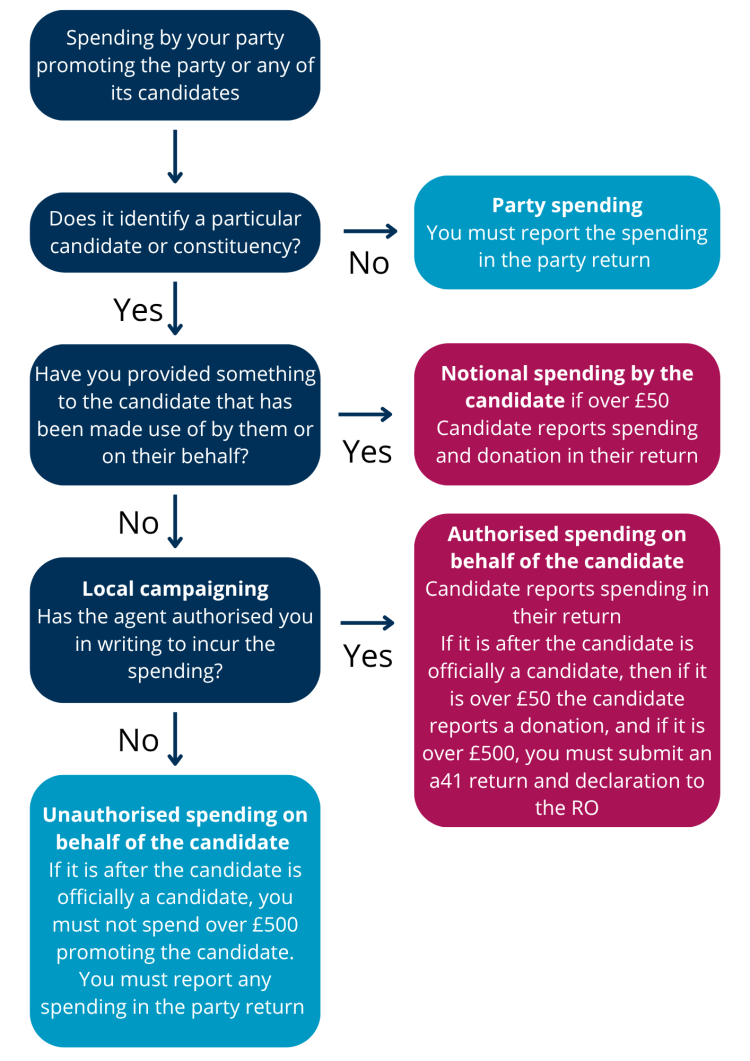
First, you should identify if your activity promotes a particular constituency candidate during the candidate regulated period. If it does, then the next question is how the spending must be reported. This depends on the candidate's or agent's link to the activity.
- 1. s72 PPERA, with s80, s75 and s76 ↩ Back to content at footnote 1
- 2. a39(3) SPEO ↩ Back to content at footnote 2
- 3. a49 SPEO ↩ Back to content at footnote 3
Promoting a candidate
Activity promoting your party will be regarded as promoting a constituency candidate1 whenever the activity either:
- identifies the specific candidate
- identifies the specific constituency in which the candidate is standing
examples of promoting a candidate
Example A
A political party produces a letter that sets out the party’s policies and in the final lines it asks voters to vote for a specific candidate in that constituency. Since the candidate is identifiable, the letter is to be regarded as distributed for the purposes of the candidate’s election.
Example B
A political party produces an advert that sets out the party’s policies and asks voters to vote for the party in that constituency. Although the advert does not name the candidate, it identifies the constituency. Therefore, the advert is to be regarded as distributed for the purposes of the party’s candidate’s election.
Example C
A political party produces a letter that sets out the party’s policies and encourages voters to vote for the party. Although the letter is addressed to a household in a constituency, the letter itself does not identify the candidate or the constituency. This is not to be regarded as used for the purposes of the candidate’s election. This is just party spending.
Example D
A political party holds a public campaign event. Party figures promote the party at the event. They also spend 25% of the event promoting the local party candidate. That 25% of the event is to be regarded as used for the purposes of the candidate’s election.
- 1. a58(3) SPEO ↩ Back to content at footnote 1
Reporting
If your spending promotes the party but not any particular constituency candidate, then it must be reported as party spending.1
Spending which promotes a particular constituency candidate but does not appear in a candidate return must also be reported as party spending.
However, any spending which must appear in a candidate return is excluded from party spending.2
There are two ways that your activity could need to appear in a constituency candidate return:
- notional spending by the constituency candidate
- authorised spending by the party on behalf of the constituency candidate
Notional spending by the candidate
If you have provided or transferred something to the candidate, and it is then used by or on behalf of the candidate in the candidate regulated period, and if the value is over £50, then this will be notional spending by the candidate.3
In this case, the constituency candidate must report the spending. Since it must appear in the candidate return, the spending does not need to appear in the party return.
If the candidate receives it after they have become a candidate, this will also be a donation from the party to the candidate, and must also be reported as a donation in the return.4
Authorised spending
If you have not provided or transferred anything to the candidate, but if you have spent money promoting them after they are officially a candidate, this is what is sometimes called ‘local campaigning’.
You must get written authorisation from the candidate’s agent if you are going to spend more than £500 promoting a particular constituency candidate.5
If the agent authorises you to incur the spending, then you are also authorised to make the payments for that spending.6 If you do make the payments, then if it is received after they are officially a candidate and it is over £50 it will be a donation to the candidate.7
The authorised spending must be reported by the agent in the candidate return.8
Because it must appear in the candidate return, it does not need to appear in the party return. However, if you incurred over £500, then you must also complete a separate return and a declaration. You must submit these to the Returning Officer in the candidate’s constituency within 21 days of the result being declared.9
Unauthorised spending
If the agent has not authorised you to incur the spending, then it does not need to appear in the candidate return. In this case, you must include it in your party return as usual.10
It is an offence to spend more than £500 promoting any particular constituency candidate once they are officially a candidate without getting written authorisation from the agent.11
- 1. s72 PPERA ↩ Back to content at footnote 1
- 2. s72(7)(a) PPERA ↩ Back to content at footnote 2
- 3. a60 SPEO ↩ Back to content at footnote 3
- 4. a36 SPEO & Sch 2A Representation of the People Act 1983 (RPA) ↩ Back to content at footnote 4
- 5. a41 SPEO ↩ Back to content at footnote 5
- 6. a38(4)(ba) SPEO ↩ Back to content at footnote 6
- 7. a36 SPEO & Sch 2A RPA ↩ Back to content at footnote 7
- 8. a47(1)(a) SPEO ↩ Back to content at footnote 8
- 9. a41(5) SPEO ↩ Back to content at footnote 9
- 10. s72 and s80 PPERA ↩ Back to content at footnote 10
- 11. a41 SPEO ↩ Back to content at footnote 11
Splitting spending
Why you may need to split spending
You may need to split your costs between activities and materials that count as campaign spending and those that don’t.
Here are two common examples of where you need to split spending:
- if you use your office as a base for telephone canvassing, you will need to split the phone bill between canvassing calls, and calls made for non-campaign purposes
- if you use design work for campaigning before the regulated period begins, and continue to use it after it has begun, you will need to split the design costs between the two periods
Splitting spending summary box 1
For example, you commission design work for a campaign logo for your party that you use on your website, other social media and on all your campaign material for a month before the regulated period starts and during the 4 month regulated period.
You should split the cost of the design equally across the entire time that you use it in this way.
The design work cost £15,000, and you used it over a 5 month period, so the cost per month is £15,000 ÷ 5 = £3,000 a month.
The regulated period covered the final 4 months, so the cost of spending during the regulated period is:
4 x £3,000 = £12,000
£12,000 must be recorded as party campaign spending
Splitting between candidate and party spending
Splitting between candidate and party spending
You may also need to split your costs between the party and a constituency candidate, if the spending has been authorised by the candidate’s agent.
For example, you might hire a car for a staff member who spends some of their time working on the party’s regional campaign, and the rest working for a constituency candidate in a particular constituency.
You should only divide the costs of an item between the party and candidate spending limits if you are sure that it is reasonable to do so.
For printed material such as leaflets, you can split the costs of physically distinct parts of the leaflet, such as separate pages or sides. You should only split the costs if there is no reference to a candidate or constituency in a particular part of the leaflet. You should not split the costs between the content in a part of the leaflet, for example by paragraph or sentence.
You should not divide the costs of an item if it is produced mainly to promote a constituency candidate, and uses the party’s name or refers to the party’s policies purely in support of that aim.
splitting eg1
Example A
A leaflet has four pages. Three are produced locally and promote the constituency candidate. The content on the fourth page is created by the national party and focuses on the party’s national policies only, with no mention of the candidate or constituency.
Since the page of the leaflet promoting the party is physically distinct, the party counts 25% of the leaflet costs to the party limit. The remaining costs will count towards the candidate’s spending limit, if it is made use of by or on behalf of the candidate (see notional spending), or if it has been authorised by the candidate’s agent.
Example B
A leaflet focuses on a constituency candidate but includes some of the party’s key pledges throughout as a way of telling voters what the candidate stands for.
There is no physically distinct part of the leaflet that does not promote the candidate, so the whole leaflet is promoting the particular candidate.
The full costs of the leaflet will therefore count towards the candidate’s spending limit, if it is made use of by or on behalf of the candidate (see notional spending), or if it has been authorised by the candidate’s agent.
The honest assessment principle
The honest assessment principle
In all cases you should make an honest assessment, based on the facts, of the proportion of spending that can fairly be attributed to your campaign.
Sometimes, it may be difficult to make an exact split. For example, your telephone bill may only provide a breakdown of the cost of calls over a certain value.
In these cases, you should consider the best way of making an honest assessment on the information you have. For example, you could compare the bill with one that does not cover a regulated period.
If you are still not sure, call or email us for advice.
When you submit your spending return you must declare that the return is complete and correct to the best of your knowledge and belief. This declaration covers any assessments you have made about splitting spending.
It is an offence to make a false declaration knowingly or recklessly.1
- 1. s83 PPERA ↩ Back to content at footnote 1
Time limits for receiving and paying invoices
There are time limits by which the responsible person must receive and pay all invoices for your campaign spending.1
Receiving invoices from suppliers
You must obtain all your invoices for your campaign spending from suppliers within 30 days of the election. The last day for receiving invoices from your suppliers is Monday 8 June 2026.2
Invoices received after this deadline are called unpaid claims for the purposes of reporting. You must record unpaid claims in your spending return.
You must not pay unpaid claims unless there is a court order enabling you to do so. This is called leave to pay and may be obtained by you or the supplier applying to the relevant court in advance of payment.
Paying invoices from suppliers
You must pay all your invoices from suppliers within 60 days of the election. The last day for paying invoices is Monday 6 July 2026.3
If this date falls on a weekend, Bank Holiday or other public holiday it is moved to the next working day.
Invoices received in time but remaining unpaid after this deadline are called disputed claims.4 You must record disputed claims in your spending return.
You must not pay disputed claims unless there is a court judgment or order enabling you to do so. This is called leave to pay and may be obtained by you applying to the relevant court in advance of payment. Suppliers may also apply to the relevant court to obtain a court judgement or order for payment.
Enforcement
We may issue a civil sanction for a breach of these rules.
However, we will not usually consider taking enforcement action to be proportionate where the delay or amounts are small.
Final decisions on prosecution for receiving and paying late invoices are made by the Crown Office/Procurator Fiscal.
- 1. s77 PPERA ↩ Back to content at footnote 1
- 2. s77(1)&(9) PPERA ↩ Back to content at footnote 2
- 3. s77(2) PPERA ↩ Back to content at footnote 3
- 4. s78 PPERA ↩ Back to content at footnote 4
Your spending return
You must report your campaign spending to us after the election.1
You must record all your campaign spending. You will need to send us this information in your spending return after the election.
All costs must include VAT, even if VAT does not appear on the invoice, or you can recover VAT payments.
What you need to record
For each item of spending, you must record the following information to put into your spending return:
- what the spending was for – for example, leaflets or advertising
- the name and address of the supplier
- for a payment made, the amount
- for notional spending, the value2
- the date that you spent the money
- any invoices not received by the deadline (unpaid claims)3
- any payments not made by the deadline (disputed claims)4
You must also include invoices or receipts for any payments over £200.5
Invoices are not required for notional spending, since it is not a payment, but the value of something that has been provided. It is good practice to include evidence of how you calculated the value.
The return must be accompanied by a declaration from the responsible person to say that the return is complete and correct.6
It is a criminal offence to make a false declaration knowingly or recklessly.
You can report your campaign spending via PEF Online.
We also provide a template form for you to use to help you keep records and complete your return. We recommend you use either PEF Online or our template to ensure you are providing the details required by law.
You can download the form below and submit the completed form to us by email at [email protected] or you can post it to us.
If you are posting your return, we recommend that you post it in time to arrive no later than the last working day before the deadline.
Donations and loans
Donations and loans are reported by parties on a quarterly basis when they exceed a certain threshold or are impermissible.
There are no additional requirements on parties for reporting donations and loans at the Scottish Parliamentary election.
Donations given to help with the campaigns of party list candidates will count as donations to the party.
Your party’s registered treasurer is responsible for making sure that the party follows the law on donations and loans. You should ensure that you have systems in place for party list candidates and agents to provide the treasurer with all the necessary information about donations and loans they receive.
Please see our guidance on party donations and loans for more information.
- 1. s80 & Sch 9 para 5 PPERA ↩ Back to content at footnote 1
- 2. s80(4)(b) PPERA ↩ Back to content at footnote 2
- 3. s80(3)(b) PPERA ↩ Back to content at footnote 3
- 4. s80(3)(c) PPERA ↩ Back to content at footnote 4
- 5. s80(4)(a) & s76(2) PPERA ↩ Back to content at footnote 5
- 6. s83 PPERA ↩ Back to content at footnote 6
Campaign reporting deadlines
The date by which you must report to us depends on how much you spent on your campaign. The deadlines are shown below.1
| Campaign expenditure of £250K or below | Campaign expenditure of over £250K |
|---|---|
| Report within three months of the election | Report within six months of the election |
| Friday 7 August 2026 | Saturday 7 November 2026 |
You may be liable for a penalty if you don’t submit your return on time.
If your campaign expenditure is over £250k you must include an independent auditor’s report.2
For more information see this document:
- 1. s82 PPERA ↩ Back to content at footnote 1
- 2. s81 PPERA ↩ Back to content at footnote 2