About this guidance
This guidance covers print and digital imprints for non-party campaigners at Scottish Parliamentary elections and council elections in Scotland.
It incorporates relevant contains sections from both the UK statutory guidance and the Scottish statutory guidance on digital imprints. Showing that you have acted in accordance with either of these guidance documents provides a statutory defence.
Where the guidance says that something ‘must’ be done, this means that it is a requirement in either primary or secondary legislation.
The guidance uses ‘you’ to mean both the promoter of the material, and anyone else on whose behalf it has been published.
Key terms are explained throughout the guidance, and also provided in an alphabetical list at the end of the document.
The examples of digital material used in this guidance relate to functionality on digital platforms as of June 2025. The general principles set out in the guidance continue to apply in the event that functionality changes, or new platforms emerge.
Introduction
Under the Political Parties, Elections and Referendums Act 2000, the Representation of the People Act 1983 and the Scottish Parliamentary (Elections etc) Order 2015 the law requires imprints to be displayed on some kinds of printed material.
Under the Elections Act 2022 and the Scottish Elections (Representation and Reform) Act 2025, the law requires imprints on some kinds of electronic material. This guidance refers to electronic material as ‘digital material’.
If you publish material without an imprint when one is required, you may be committing an offence.
What is a non-party campaigner?
Non-party campaigners are individuals or organisations that campaign at elections, but are not standing as political parties or candidates. Campaigners being able to get their messages to voters is a fundamental part of the democratic process, and it is important that voters hear from a wide and diverse variety of campaigners.
In electoral law, these individuals or organisations are called ‘third parties’.
Non-party campaigners who spend over a certain amount on campaigning at elections must register with the Electoral Commission.
Where non-party campaigners have registered with the Electoral Commission they are called ‘recognised third parties’. In our guidance, we call recognised third parties ‘registered non-party campaigners’.
What is an imprint?
When certain campaign material is published, it must contain specific details to show who is responsible for publishing it.
These details are known as an ‘imprint’. The imprint helps to ensure there is transparency for voters about who is campaigning.
Unlike a political party, where a lot of their material is likely to require an imprint, if you are a non-party campaigner that campaigns on an issue, you may find that only some of your material requires an imprint. You should consider whether an imprint is required for each piece of material, according to the facts.
Imprints are important for transparency in campaigning. It is therefore good practice to include an imprint on all material that relates to elections, referendums and recall petitions, even if the material does not need to include one by law.
If a campaigner includes an imprint on their material, that does not mean that the material requires one by law. The campaigner may well simply be including one to aid transparency.
What is digital material?
An imprint may be required on any digital material, provided the material meets the criteria which are set out in the following sections.
Digital material is material in electronic form that consists of or includes text, moving images, still images, speech or music.
It does not include telephone calls or SMS messages. It can apply to material published in messaging services which do not use SMS, such as WhatsApp or Signal.
The requirement to include an imprint only applies to digital material that is published, which means made available to the public or any section of the public. For example, it would not apply to a private messaging group between friends, or an email sent out by a party only to its members.
If material is made available in the UK, then the digital imprint rules will apply, no matter where the content is published from, or where the promoter is. For example, you could be outside the UK, but publish material on a digital platform making it available to a section of the public in the UK.
Imprints may be required on published material including (though this is not an exhaustive list):
- Pop-up ads
- Social media posts
- Any advert that appears in any website, search engine result, app or social media platform
- Adverts on internet radio or other audio streaming platforms such as Spotify
- Adverts on digital TV streaming services
- Adverts in podcasts
- Adverts in online newspapers
- Messages on WhatsApp, Signal or Telegram
- MMS messages
- Websites
- Images
- Videos
- Electronic billboards
Definitions of material in scope of the regime may also be updated by secondary legislation to allow for emerging technology.
What sort of material requires an imprint?
Printed material
Non-party campaigners at Scottish Parliamentary elections or council elections in Scotland must include an imprint on any printed election material.
This requirement applies to all non-party campaigners.
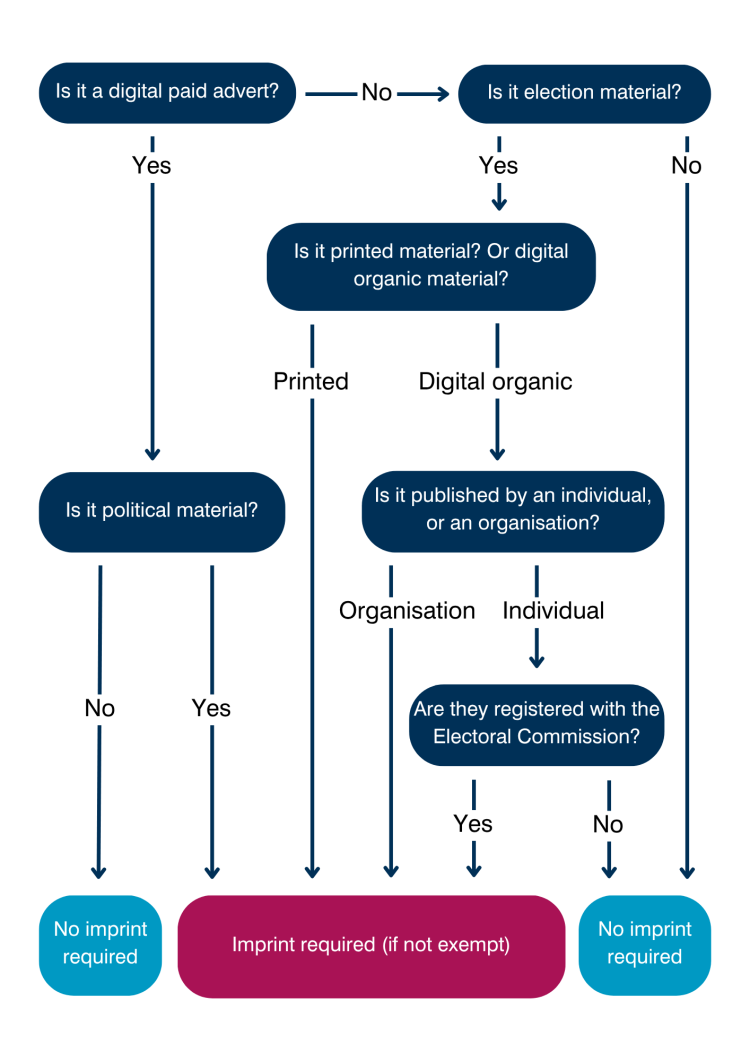
Digital material – paid adverts
If you have paid for the material to be published as an advert, then it must have an imprint if it is ‘political material’.
This requirement applies to anyone publishing political material as a paid advert.
Digital material – organic material
If you have not paid for the material to be published as an advert – for example, you just posted it on your own social media – then it is 'organic material'.
The imprint requirements for organic digital material apply differently to individuals and organisations.
Non-party campaigners at Scottish Parliamentary elections or council elections in Scotland must include an imprint on any organic election material.
This requirement applies to:
- all registered non-party campaigners
- all non-party campaigners that are organisations
Individual non-party campaigners who are not registered with the Electoral Commission do not need to include an imprint on organic material.
Exemptions
There are also exceptions for some kinds of material under the Elections Act. This guidance refers to these as exemptions.
Paid adverts
If you have paid for digital material to be published as an advert, then it must have an imprint if it is ‘political material’. This requirement applies to anyone placing a paid advert.
Payment includes payments of any kind – for example ‘pay-per-click’ and ‘pay-per-impression’ advertising.
Payment is not limited to just money. It can also include benefits in kind, for example goods or services being provided for free or at a discount by the promoter to the digital platform hosting the advert.
It does not include payments as part of the costs of creating, setting up, operating or maintaining the material. It is limited to payments made specifically to the service provider or platform hosting the adverts for the publication of those adverts. If the service provider hosting the advert (for example, a digital platform or electronic billboard advertiser) has not been paid for the material to be published on the platform, then the material is not a paid advert.
Example
For example, if you employ a digital agency to pay social media platforms for placing adverts on their platforms, then these are paid adverts because the agency is paying the platforms for the adverts to be published.
By contrast, if you employ a digital agency to publish digital material on their own social media channels, then these are not paid adverts, because the platforms on which the material is published are not being paid. The fact that the agency is being paid does not make the material a paid advert.
Similarly, if you pay an influencer or ambassador to post material on their own social media channels, then these are not paid adverts, because the platforms on which the material is published are not being paid for the material to be published. This is the case even if the posts are classed as adverts for the purposes of other legislation.
Paid adverts2
Not all payments to the service provider hosting the material will mean the material is a paid advert – only those made to the service provider specifically for the material to be published as an advert.
Example
For example, if you pay a social media company for a certain type of account (e.g. the paid Twitter Blue account on Twitter), this does not make all your posts paid adverts.
By contrast, if you pay a social media company to increase the reach of a post by publishing it as an advert (e.g. boosting a post on Facebook), then this will be a paid advert.
Paid adverts3
If material is not a paid advert, then it is ‘organic material’. Organic material may still require an imprint – see the section ‘Organic material’.
Political material
Political material is material whose sole or primary purpose can reasonably be regarded as intended to influence the public, or any section of the public, to give support to or withhold support from:
- one or more political parties
- a particular candidate or a particular future candidate (in their capacity as such)
- a particular elected office-holder (in their capacity as such)
- political parties, candidates, future candidates or elected office-holders that are linked by their support for or opposition to particular policies, or by holding particular opinions
- other categories of candidates, future candidates or elected office-holders that are not based on policies or opinions – for example, candidates who went to a state school, or MPs who grew up in their constituency
- the holding of a referendum, or a particular outcome of a referendum
- any combination of the above
The following are examples of digital paid adverts that constitute political material:
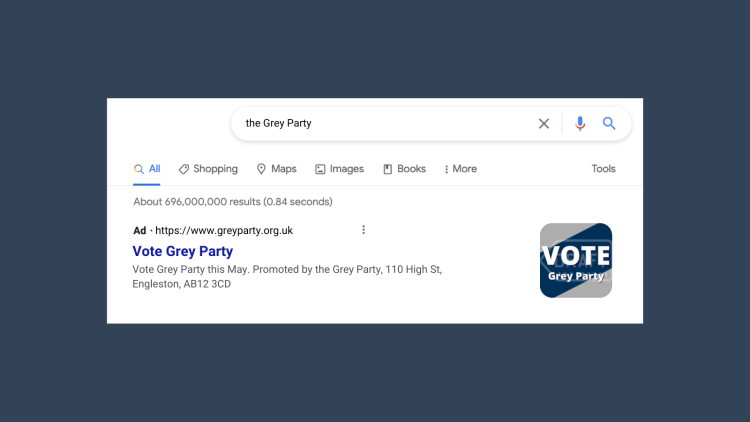
Political material whose sole or primary purpose can reasonably be regarded as intended to influence the public, or any section of the public, to give support to a political party.
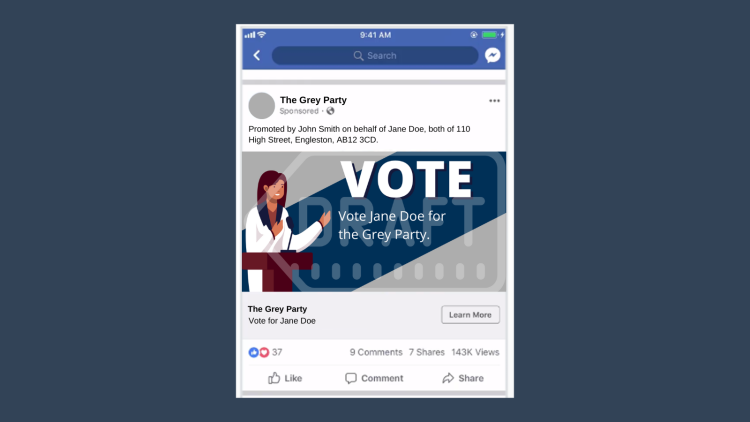
Political material whose sole or primary purpose can reasonably be regarded as intended to influence the public, or any section of the public, to give support to a particular candidate.
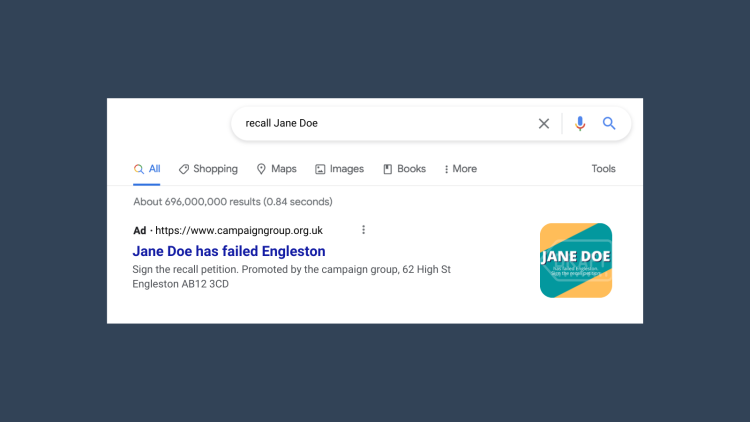
Political material whose sole or primary purpose can reasonably be regarded as intended to influence the public, or any section of the public, to withhold support from a particular elected office-holder.

Political material whose sole or primary purpose can reasonably be regarded as intended to influence the public, or any section of the public, to withhold support from a particular elected office-holder.
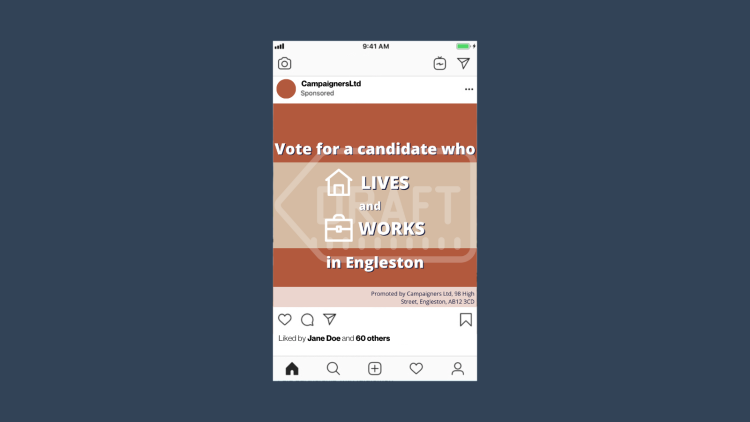
Political material whose sole or primary purpose can reasonably be regarded as intended to influence the public, or any section of the public, to give support to or withhold support from a category of candidates linked by something other than their support for a policy.
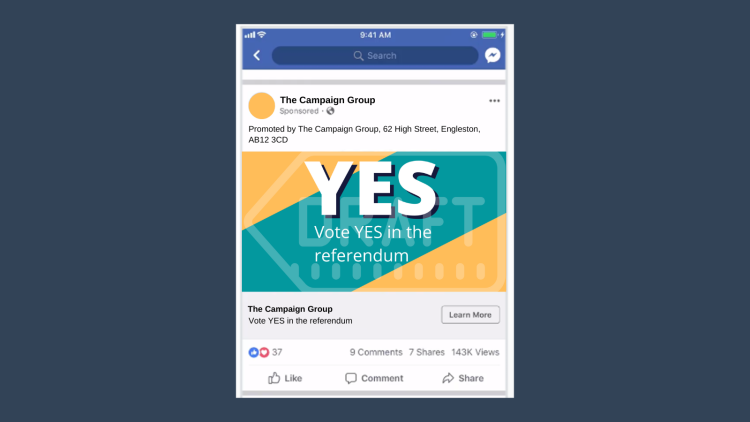
Political material whose sole or primary purpose can reasonably be regarded as intended to influence the public, or any section of the public, to give support to the outcome of a referendum.
Material can be political material at any time, not just in election or referendum periods. For example, you could pay for a digital advert promoting a party or elected office-holder at any time, without it being related to an electoral event.
Paid adverts only need an imprint if their sole or primary purpose can reasonably be regarded as one of those on the list above.
Example
For example, a sponsored Facebook post of a comedian doing a routine criticising a government minister would not usually need an imprint, because the primary purpose of the clip is usually reasonably regarded as being to promote the comedian.
Political material2
If an organisation publishes digital material, the sole or primary purpose of any given piece of material will not always be the same as the overall purpose of the organisation. It will be a matter of fact in each case whether the sole or primary purpose of any particular piece of material can reasonably be regarded as being one of those in the list above.
In particular, where the primary purpose of a specific piece of material is to do with a campaign issue itself and not any of those on the list above, then it will not be political material.
Example
For example, suppose a campaigning organisation in 2023 has as its main objective to bring back the death penalty. It runs three sets of paid adverts.
The first criticises a political party which is opposed to the death penalty. The primary purpose of this material can reasonably be regarded as to influence the public to withhold support from the party. Therefore it requires an imprint.
The second argues for holding a referendum on reinstating the death penalty. The primary purpose of this material can reasonably be regarded as to influence the public to give support to the holding of a referendum. Therefore it requires an imprint.
The third advert lists a number of positive predictions about the effects of reinstating the death penalty. The primary purpose of this material can reasonably be regarded as to influence the public to support the death penalty. Therefore it does not require an imprint.
Although the organisation has an overarching primary organisational purpose, the different pieces of digital material it publishes have distinct primary purposes. This means that some of the material requires an imprint and some does not, depending on the facts.
Election material
Printed material, and organic digital material (unless it is published by an unregistered individual campaigner), must contain an imprint if it is election material.
Election material is material whose purpose can reasonably be regarded as intending to promote or procure electoral success for:
- one or more political parties
- a candidate or future candidate
- political parties, candidates, or future candidates that are linked by their support for or opposition to particular policies, or by holding particular opinions
- other categories of candidates or future candidates that are not based on policies or opinions – for example, candidates or future candidates who went to a state school, or independent candidates (who do not stand for a political party)
- any combination of the above
It includes material that can reasonably be regarded as intended to influence voters to vote for or against one of the entities listed above – for example it includes both a positive campaign about a party’s policies, and a negative campaign criticising a party’s policies.
Election material is very similar to material which meets the ‘purpose test’ for regulated non-party campaigner spending (see the Commission’s spending guidance for more information). If you have determined that your organic digital material meets the purpose test, then it will also need to carry an imprint.
If material meets any of these criteria, it will be election material even if the material can reasonably be regarded as intended to achieve other purposes as well.
Intention
The primary intention of your material may not be to influence voters. For example, you might publish material with one or more of the following intentions:
- raising awareness of an issue
- influencing political parties to adopt a policy in their manifestos
- campaigning for or against government legislation
- providing information to voters
- encouraging people to register to vote
- encouraging people to vote, but not for anyone in particular
Even if your primary intention is something else, your material will still be election material if it can reasonably be regarded as intended to influence voters to vote for or against certain parties, candidates or future candidates.
For example, suppose your intention is to influence political parties to adopt a policy. If you go about this by publishing material promoting parties and candidates who have already adopted the policy, then this will be election material because the purpose of your material can reasonably be regarded as being to influence voters to support those parties and candidates.
Examples
The following are examples of organic material that constitute election material:





If issues-based material cannot reasonably be regarded as intended to influence voters to vote for certain parties, candidates or future candidates, then it is not election material.

egs
More examples are included below.
eg1
Before the regulated period starts, an animal welfare organisation publishes a series of posts on social media explaining what it regards as mistreatment of animals in captivity. As well as setting out problems, it argues that one of the causes is government policy and underfunding. It does not mention elections, candidates or political parties.
This is not election material and does not require an imprint. Although the material is critical of the government, it is not reasonably regarded as intended to influence voters in an election.
Eg2
Two months before a Scottish Parliamentary general election, the animal welfare organisation, that is registered with the Electoral Commission, shares, without commenting on it, a news article reporting that the party of government has announced they will undertake a rewilding programme if they are re-elected.
This is not election material. This is merely sharing information, and the organisation would be expected to share any news relevant to their work. No imprint is required.
Eg3
Once all the main parties have launched their manifestos in advance of a Scottish Parliamentary general election, the registered non-party campaigner compares their manifesto pledges on rewilding. They create a graphic comparing the parties’ positions on the issue, giving marks out of ten and saying which party has the best policies. They then publish the graphic on their own social media channels.
Because the campaigner has compared the parties and said which is better in this context, they have effectively promoted some over others. The graphic is therefore reasonably regarded as promoting those parties the campaigner considers to have better policies, so is election material. An imprint is required on the material.
What material does not need an imprint?
The following types of material do not need to carry an imprint even if they meet the relevant test:
- Material, other than an advert, published on a website or app which is primarily for journalism
- Organic digital material published by an individual non-party campaigner who is not registered with the Electoral Commission
- Certain shared material which still includes the original imprint. See Sharing and republishing digital material for more details
Material published on a website or app which is primarily for journalism
Material, other than an advert, which is published on a website or mobile app whose primary purpose (or one of whose primary purposes) is journalism does not need to include an imprint. This exemption does not apply to adverts, regardless of whether the platform has been paid to publish the advert or not.
Websites or apps which have journalism as one of their primary purposes can include for example:
- Online newspapers or news channels
- Newspaper apps
- Online radio stations
Print newspapers and periodicals
Material published as a part of the editorial content of a print newspaper or periodical does not need to include an imprint.
Adverts in print newspapers and periodicals must include an imprint if they are election material.
Organic digital material – unregistered individual campaigners
If you are an individual non-party campaigner who is not registered with the Electoral Commission, then you do not need to include an imprint on any organic digital material you publish on your own behalf.
Unregistered individuals who only publish material on their own behalf will only need to include an imprint on paid adverts.
What information must you include in the imprint?
For digital material, you must include the name and address of:
- the promoter
- any person on behalf of whom the material is being published (and who is not the promoter)
For printed material, you must also include the name and address of:
- the printer
You must use a postal address where you can be contacted. It can be an office or business address, or a home address. You can also use a PO Box address, or other mailbox service.
The imprint must be in text form, unless it is included as a part of solely audio material. In this case, the imprint must be included as audio material.
The promoter and anyone on whose behalf the material is being published
The promoter is whoever has caused the material to be published.
Both the promoter and any person on behalf of whom the material is being published may be an individual or an organisation.
If the material is published by an organisation, then the promoter is the organisation itself. The details of an individual are not required.
Eg1
For example, if an employee of a registered non-party campaigner publishes material for the campaigner in the course of their role as an employee, then it is the non-party campaigner itself who is the promoter and whose details must be provided.
What info 2
The imprint must include the details of both the promoter and anyone else on whose behalf the material has been published. This means that your own details will not always be enough to meet the imprint requirements, depending on your particular situation.
Eg 2
For example, if an agent publishes material on behalf of their candidate, then the imprint must include both the details of the agent, as promoter, and of the candidate on whose behalf the material has been published.
For another example, suppose someone is an agent for a candidate, and also publishes material as part of their role volunteering for a political party. Some of the material they promote will be on behalf of the candidate, and so need to include the agent’s details as promoter, and the candidate’s details as the other person on whose behalf the material has been published. Some of it will be for the party, and so need the details of the party instead.
What info 3
Material could be published on someone’s behalf for a number of reasons, including:
- the role someone plays in a campaign – for example, an agent may publish material on behalf of their candidate, making the agent the promoter.
- they are paying for a service – for example, a social media influencer may publish their own organic material on behalf of the political party that has engaged them to do so, making the influencer the promoter.
- they are part of a wider group involved in publishing the material – for example, a non-party campaigner may publish material on behalf of a coalition of non-party campaigners, making that non-party campaigner the promoter.
If you are being paid to publish the material, the material must include an imprint which includes the details of whoever is paying you. This is because, depending on the facts, either they are the promoter, or you are publishing the material on their behalf.
If you are an organisation that receives donations for your general operations, this does not mean that material you publish is published on behalf of your donors.
If a staff member or volunteer publishes their own material of their own accord, in their personal capacity on their own social media accounts, this will not count as being done on behalf of their organisation.
For digital material, there is no equivalent of the printer, whose details are required on print imprints. No details are required of entities simply hosting material, such as internet service providers and social media companies, unless they promote their own material.
How big must the imprint be?
Printed material
For printed material regarding a particular candidate at Scottish Parliamentary elections, there is a minimum size for imprints. For printed material of size A4 or larger:
- the type must be at least as big as size 11 Times New Roman without being narrowed
- there must be a space between text lines of at least 3mm
For printed material smaller than A4:
- the type must be at least as big as size 9 Times New Roman without being narrowed
- there must be a space between text lines of at least 2mm
We recommend that your imprints are also this size on other printed material.
Digital material
For digital material, the imprint must be legible, or in the case of audio material, audible, no matter what device is used to access the information.
In order to comply with the law, you must ensure that a written digital imprint is on screen for long enough that it can be read. Similarly, an audio imprint must be read at a speed at which it can be heard and understood.
Where must the imprint appear?
Printed material
If your material is a single-sided printed document – such as a window poster – or where most of the information is on one side, you must put the imprint on that side of the document.
If it is a multi-sided printed document, you must put it on the first or last page.
Digital material
The imprint must be included as a part of the material, unless it is not reasonably practicable to do so.
Whether it is reasonably practicable to include the imprint as part of the material depends on the technical capability of the platform on which the material is published.
It does not depend on, for example, whether including an imprint will affect:
- your preferences about the design or appearance of the material
- how effective you think the material will be
- how much time it will take to publish the material
If the imprint is included as a part of the material, it must be included in such a way that if the material is shared as it is, the imprint will still be a part of it.
Eg 1
For example, if the material is a picture and contains an imprint, then if the picture is shared unaltered, the imprint will still appear.
Where 2
If it is not reasonably practicable to include the imprint as a part of the material, then the imprint must appear somewhere directly accessible from the material. In practice, this means it can be reached via a direct link, usually one click or equivalent, where both the link and the imprint are easy for a voter to locate.
If the imprint appears somewhere directly accessible from the material, it must be included in such a way that it if the material is shared as it is, the imprint will still be accessible from the shared material.
Eg 2
For example, if the material is a post on X, and the imprint is included in your bio, then if the material is reposted, the imprint in your bio will still be accessible from the repost.
Where 3
This means that you must not delete the imprint from your bio for as long as an imprint is required and the material remains published. If you were to delete the imprint, then it would no longer be accessible if your material is shared.
Similarly, you cannot include your imprint somewhere which would not be accessible by those who can view the material itself.
Eg 3
For example, the imprint cannot be behind a paywall or otherwise protected area of the internet, if that would mean that voters would see the shared material but would not have the necessary permission to view the imprint itself.
Where 4
Beyond these requirements, the original promoter of the material is not liable for any imprint offences that are due to the material being shared by other people later on. The liability is on the people republishing the material – see Sharing and republishing digital material.
If the imprint is included somewhere directly accessible from the material, it must be clear that the imprint relates to the material. For example, it would not be acceptable to publish a list of different imprints in one location, directly accessible from lots of different material, without it being clear which imprint relates to which material.
The next sections give some detailed guidance on particular types or categories of digital material, and on what is typically reasonably practicable.
Social media
Usually, the material on social media will be the whole social media post. You must include the imprint in the post itself, unless it is not reasonably practicable.
Eg 1
For example, for paid adverts on Facebook, it will usually be reasonably practicable to include the imprint as a part of the material – you can either include the imprint in the video or image content, or in the surrounding text.
Social media 2
On some digital platforms, the design of the platform, such as there being a character limit on posts, may mean that it is not reasonably practicable to include the imprint as a part of the post. In this case, you must display a legible imprint somewhere directly accessible from the post. The imprint must be directly accessible from the post no matter what device is used. There are a number of different ways that you can do this.
Eg 2
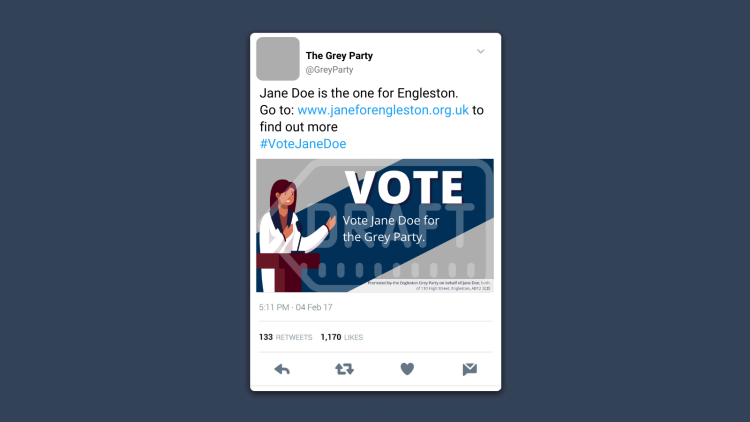
For example, on X, it may often not be reasonably practicable to include the imprint in the post itself because of a character limit. If this is the case, your imprint can be included on your profile, for example underneath your name, or as a pinned post or tweet. Alternatively the imprint can be included somewhere else that you directly link to from your post, for example on your own website.
pinned post

insta

Social media 3
Usually the ‘About’ section of a profile on a digital platform is not directly accessible from a post, because the hyperlink to the profile does not directly take you to that section. In this case, the ‘About’ section will only be directly accessible from a post if you add your own direct link to the ‘About’ section into the post.
If material requires an imprint, you must ensure it is published on a platform that enables you either to include the imprint as part of the material or, if not reasonably practicable, somewhere directly accessible from the material. If a platform has such limited functionality that you cannot do either, then material that requires an imprint must not be published on that platform.
If you publish material that requires an imprint on a platform that has limited functionality, you must include the imprint no matter what the limitations of that platform are. For example, TikTok has an 80-character bio, you cannot include links in a caption, and pinned posts are not available to all users. The best way to avoid these limitations is to include the imprint within the content of your TikTok video itself.
Videos, images and cartoons
A video or image can still be required to display an imprint even if it contains no text.
If your material is a video or image, it will usually be reasonably practicable to include the imprint in the video or image, especially if you have created it yourself. If this is not reasonably practicable, for example if the material is a very small image, you must include the imprint somewhere directly accessible from it.
If your material is a social media post which contains a video or image, then it will usually be reasonably practicable to include the imprint as a part of the post. Where it is reasonably practicable to include the imprint as part of the post, the best way to do this is to include it in the content of the video or image itself.
This is because if it is shared, the imprint is more likely to remain a part of the material. This means that voters will see the original imprint as it is shared, which provides the most effective transparency. It is also less likely that people sharing the material will be required to include their own imprint when they share it. Further detail is included in the section Sharing and republishing digital material.
Alternatively, you can include the imprint somewhere else in the post. For example when uploading a video to YouTube, you can include the imprint in the video’s description.
Youtube video digital imprint example

Websites
Where the digital material is a website or webpage, it will usually be reasonably practicable to include the imprint on the relevant webpage. For example, it could be displayed in the footer.

Where the material is just a part of the webpage, for example a social media post embedded in the page, then the imprint must be included as a part of the material unless it is not reasonably practicable.
If it is not reasonably practicable, then it can appear somewhere directly accessible from the material – for example, somewhere else on the same webpage, such as the footer, or somewhere hyperlinked from the material.
eg
For example, if your material is a Google search advertisement, the character limit of the description may not be sufficient to contain the information required by the imprint in the material itself. In this case, you can include the imprint somewhere directly accessible from the Google search advertisement, such as the page that the advert links to.
Audio material
On solely audio material, the imprint must be included as a part of the material. For example, you could include someone reading out the imprint at the end.
The imprint must be audible.
The imprint must be read at a speed at which it can be heard and understood.
For how long does material need an imprint?
In all cases, digital material must include an imprint for as long as both:
- the imprint is required by the law
- the material remains published
Material remains published for as long as it is being made available to the public or a section of the public. For example, if a post remains available on your social media channels, then it remains published.
Organic material
For organic material, the imprint is required for as long as the published material remains election material.
In many cases the imprint will stop being required once the election is over.
For example, a video saying ‘Vote Grey Party on 1 May’ in relation to an upcoming election will cease to be election material after 1 May when the election is over.
Material saying just 'Vote Grey Party' might continue to be election material even after the election is over, for example if the party is standing in another election in June.
Paid adverts
For a paid advert, an imprint is required for as long as the material remains political material.
How long the material remains political material will depend on who or what your material is reasonably regarded as intended to influence public support for or against. If the material is linked to a particular electoral event or electoral cycle, then it will have a natural end point. For example:
- a future candidate could decide not to stand
- a candidate ceases to be a candidate after polling day
- an elected office-holder ceases to be an elected office-holder when their term ends
- support for or against a particular outcome in a referendum cannot be influenced after polling day
Some political material will not have such a clear end point. For example, material promoting support for or against a political party could continue doing that for as long as the party exists.
Sharing and republishing digital material
When you share material to the public or a section of the public, including on social media, this is a type of publication. In the legislation, this is referred to as ‘republishing’. The law on imprints therefore also applies to material that you share – for example, using the ‘repost’ function on X, the ‘Share’ button on Facebook, the ‘duet’ function on TikTok, or forwarding an email.
This also applies when you share material that was first published before the law on digital imprints was in force.
However, if you share material that has already been published with a correct imprint and you do not materially alter the material, then you do not need to include a new imprint with your own details. The original imprint will suffice. In this guidance we refer to this as the ‘sharing exemption’.
Materially altering the material includes:
- changing it in such a way as to change the meaning of the material
- removing the imprint (if it originally appeared as a part of the material)
- sharing it in such a way that the imprint ceases to be accessible from the material (if it originally appeared somewhere directly accessible from the material)
If you share digital material that has already been published, but
- you materially alter that material, and
- it still requires an imprint in its new form
then you must include your own imprint, even if the original material had an imprint. If you do not, you may be committing an offence.
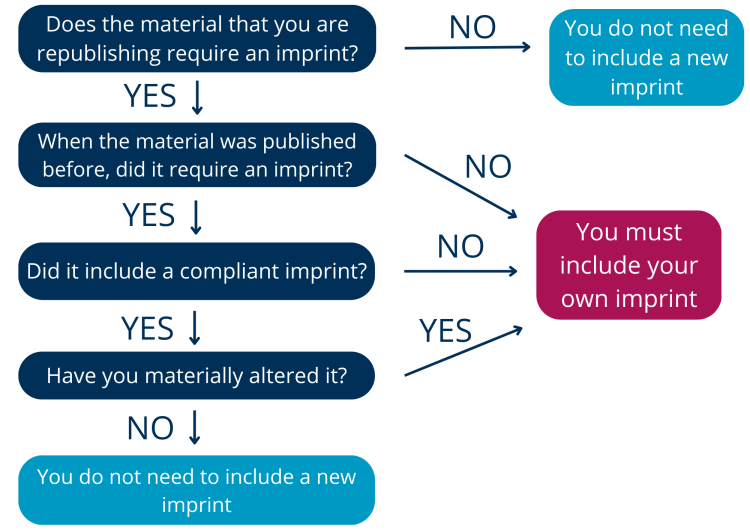
When material is republished, the duty to include an imprint falls on the person republishing the material (and anyone else on whose behalf they are republishing it).
The duty does not fall on the promoter of the original material which is now being republished. The promoter of the original material only has a duty to make sure that it is possible for the original material to be shared without losing either:
- the imprint (if it is included as part of the material)
- access to the imprint (if it is included somewhere directly accessible from the material)
In all cases, but especially if a promoter encourages the sharing of their material, it is good practice to include the imprint somewhere where it will be most easily retained if the material is shared. If the post contains an image or video, this will usually be in the content of the image or video itself.
If you are a member of the public sharing material, you will usually not need to include an imprint. This is because if you are an individual, and you are not publishing on behalf of anyone else, you do not need to include an imprint with any organic material.
Examples of sharing material
The following tables show different examples of ‘chains’ by which material is shared. Each table begins with the same piece of digital material, but in each table it is then republished in a number of different ways.
Chain of sharing organic material where the imprint is included as a part of the material:
| Example | Does it require a new imprint? Why? | What they did |
|---|---|---|
| An unregistered campaign organisation posts an image criticising a political party’s election manifesto | Yes. It is election material and the campaigner is not an individual. | The campaigner includes their imprint in the image itself. |
| The image is reposted by a registered non-party campaigner. | No. It is election material and has been shared by a registered non-party campaigner, but it is exempt under the sharing exemption. It has been shared without being materially altered and the original campaigner’s imprint is still a part of the material. | The registered campaigner does not include their own imprint. |
| Another unregistered organisation reposts the repost. | No. The sharing exemption still applies – the material is not materially altered and the original party imprint is still a part of the material, so no further imprint is required. | The campaigner does not include their own imprint. |
Chain of sharing organic material where the imprint is originally in the material but is removed during the republication.
| Example | Does it requite a new imprint? Why? | What they did |
|---|---|---|
| An unregistered campaign organisation posts an image criticising a political party's election manifesto | Yes. It is election material and the campaigner is not an individual. | The campaigner includes their imprint in the image itself. |
A registered non-party campaigner screenshots the image and turns it into a Facebook post. They crop the image so that the imprint no longer appears. | Yes. By removing the imprint, they have materially altered the material. This means the sharing exemption does not apply. Because it is election material, and they are a registered campaigner, it requires the campaigner’s imprint under the rules for organic material. | The registered campaigner does not include an imprint, and so commits an offence. |
| A campaign organisation shares the altered image using the 'Share' button on Facebook. | Yes. The sharing exemption does not apply, because the campaigner in the previous example did not include an imprint. | The campaigner must include their own imprint. It is reasonably practicable to include it in the post, so they include it above the image. |
| An individual shares the same altered image using the 'Share' button on Facebook. | No. Because it is not a paid advert, the imprint rules for organic material apply. Individuals who are not registered with the Electoral Commission, and are publishing on their own behalf, do not need to include an imprint on organic material, regardless of whether they are publishing it originally or sharing it. | No imprint is required, so the individual does not include one. |
Chain of sharing organic material where the imprint is included somewhere directly accessible from the material:
| Example | Does it require a new imprint? Why? | What they did |
|---|---|---|
| An unregistered campaign organisation posts an image criticising a political party’s election manifesto. | Yes. It is election material and the campaigner is not an individual. | The campaigner includes their imprint in the image itself. |
A candidate from the party republishes the original image using the ‘Quote’ function on X. They add a lengthy comment which is critical of the campaigner and defends the party’s manifesto. | Yes. The candidate has shared the material but turned it into election material intended to influence voters to vote for the party. Because the meaning has been changed, the material has been materially altered. This means that the sharing exemption does not apply. The candidate’s post is a new piece of material which requires an imprint in its own right. | In this case, because the candidate has used up a lot of the character limit with their comment, it is not reasonably practicable to include the imprint as a part of the post. The candidate therefore adds their own imprint underneath their name in their bio. This is directly accessible from the post because the post contains a hyperlink to the bio internal to the platform’s functionality. |
| A registered non-party campaigner reposts the candidate’s post. | No. The registered campaigner’s post still contains a hyperlink with a direct link to the candidate’s X bio. The imprint is therefore still accessible from the shared material. | The registered campaigner does not include their own imprint. |
| An unregistered campaign organisation screenshots the registered campaigner’s repost and includes it as part of a TikTok video. | Yes. Because of the way the image has been republished, there is no longer a hyperlink to the candidate's profile, where the original imprint appears. The imprint is no longer accessible from the campaigner’s republished material, so the exemption does not apply. | The unregistered campaigner candidate therefore includes their own imprint at the start of the video. |
| A registered individual non-party campaigner shares the unregistered campaigner’s video by using the stitch feature on TikTok. A section from the end of the first video appears at the start of the new video. | Yes. Because the section of the earlier video that is included does not contain the unregistered campaigner’s imprint, the material has been materially altered. The sharing exemption does not apply. | The registered individual campaigner therefore includes an imprint in their video. |
Examples where organic material is republished and turned into a paid advert:
| Example | Does it require a new imprint? Why? | What they did |
|---|---|---|
| An unregistered campaign organisation posts an image criticising a political party’s election manifesto. | Yes. It is election material and the campaigner is not an individual. | The campaigner includes their imprint in the image itself. |
| An individual campaigner pays Facebook to 'boost' the post, thereby turning it into a paid advert. | No. This is now a paid advert, and it is political material. It would usually require an imprint even though the promoter is an unregistered individual. However, the imprint is a part of the original post and is retained. The material has not been materially altered. The sharing exemption applies and the individual does not need to include their own imprint. | The individual does not include an imprint. |
| A different individual campaigner creates and publishes a meme criticising a political party and some of their elected office-holders. They do not pay for it to be published as an advert. | No. If material is not published as a paid advert, then if it is published by an unregistered individual, no imprint is required. Since the member of the public is an individual and is not registered with the Electoral Commission as a non-party campaigner, they do not need to display an imprint on organic material. | The individual does not include an imprint. |
| The first individual campaigner pays Facebook to ‘boost’ the meme, thereby turning it into a paid advert. | Yes. The original meme did not require an imprint because it was not a paid advert and was posted by an individual. However, by ‘boosting’ the post, the campaigner has turned it into a paid advert, and it is now political material.
| The individual campaigner includes their imprint in the text at the top of the advert. |
Enforcement of the regime
If material which requires an imprint is published without one, then
- the promoter of the material
- anyone else on whose behalf the material is published
- for printed material, the printer
may commit an offence.
Whether it is the police or the Electoral Commission that is initially responsible depends on the purpose of the material in question, rather than who has published it.
The police will enforce material which relates to:
- a particular candidate
- a particular future candidate
- a particular elected office-holder
The Electoral Commission will enforce material which relates to:
- political parties
- categories of parties, candidates, future candidates and/or elected office-holders including categories based on:
- their support for or against particular policies
- their holding particular opinions
- any other reason
Where there is uncertainty in a particular case as to which body is responsible for enforcement, printed material will be enforced by the Electoral Commission. For digital material, this will be resolved between the enforcement bodies on a case by case basis.
The Electoral Commission will regulate digital imprints in line with our enforcement policy.
Digital imprints included somewhere directly accessible from the material
In circumstances when a digital imprint is required, it must be included as a part of the material, unless that is not reasonably practicable.
If it not reasonably practicable, then the imprint must be included somewhere directly accessible from the material – that is, somewhere roughly ‘one click’ away, or the equivalent.
If it was reasonably practicable to include the imprint as a part of the material, but the imprint is only included somewhere directly accessible from the material, then this is an offence.
For digital paid adverts, we expect campaigners to include imprints as a part of the material, and we may consider it proportionate to take some regulatory action on this basis. This is because the expenditure involved means that there is a greater need for transparency for voters.
For organic material – that is, digital material that is not a paid advert – we are unlikely to consider that it is proportionate to take regulatory or enforcement action on this basis alone, so long as the origin of the material is clear in other ways. This is because of the partial transparency provided.
Key terms
Candidate
A candidate is a candidate at an election for a relevant elective office, including a person who is included in a list of candidates submitted in connection with such an election.
Digital material
In the legislation, digital material is referred to as ‘electronic material’.
Digital material is material in electronic form which consists of or includes:
- text, moving or still images, or
- speech or music.
It does not include material that is received by a person in the form a telephone call (e.g. to a landline telephone number) or material that is received via a text message using SMS to a telephone number.
Elected office-holder
An elected office-holder is someone who holds a relevant elective office.
An elected office-holder is to be treated as holding a relevant elective office during any period when—
- the person has been elected as, or declared to be returned as, the holder of the office, but
- their term of office has not yet begun
Election material
Election material is material that can reasonably be regarded as promoting or procuring electoral success at one or more relevant elections for:
- one or more political parties
- a candidate or future candidate
- political parties, candidates, or future candidates that are linked by their support for or opposition to particular policies, or by holding particular opinions
- other categories of parties, candidates or future candidates that are not based on policies or opinions – for example, candidates or future candidates who went to a state school, or independent candidates (who do not stand for a political party)
- any combination of the above
Future candidate
A person is a future candidate at an election for a relevant elective office if—
- the person has been declared, whether by the person or by someone on their behalf, to be a candidate at the election (and the declaration has not been withdrawn),
- the election is the next scheduled election for the office, and
- the notice of the election has not been published or, in the case of an election for the office of member of the House of Commons, the writ for the election has not been issued.
Organic material
Organic material is any digital material which is not a paid advert. That is, digtial material where neither the promoter of the material, nor the person on behalf of whom the material is published, has paid for the material to be published as an advertisement.
Paid advert
A paid advert is material where the promoter of the material, or the person on behalf of whom the material is published, has paid for the material to be published as an advertisement.
For the purposes of the definitions of ‘paid advert’ and ‘organic material’, payments are not limited to just money. They can also include benefits in kind.
They do not include payments that are part of the background costs of creating, setting up, operating or maintaining the material. They are limited to payments specifically to the service provider or platform hosting the adverts for the publication of those adverts.
Political material
Political material is material whose sole or primary purpose can reasonably be regarded as intended to influence the public, or any section of the public, to give support to or withhold support from:
- one or more political parties
- a particular candidate or a particular future candidate (in their capacity as such)
- a particular elected office-holder (in their capacity as such)
- political parties, candidates, future candidates or elected office-holders (in their capacity as such) that are linked by their support for or opposition to particular policies, or by holding particular opinions
- other categories of parties, candidates, future candidates or elected office-holders (in their capacity as such) that are not based on policies or opinions – for example, candidates or future candidates who went to a state school, or MPs who have had a job outside of politics
- the holding of a referendum, or a particular outcome of a referendum
- any combination of the above
Promoter
The promoter is the person causing the material to be published.
Publish
To publish is to make available to the public at large or any section of the public.
Recall petition
A recall petition is a mechanism under the Recall of MPs Act 2015 by which a sitting MP may be “recalled” by their constituents during the lifetime of a parliament, potentially resulting in a by-election.
Recall petition material
Recall petition material is material that promotes or procures the success or failure of a recall petition.
Recall petition campaigner
A recall petition campaigner is a person who is an accredited campaigner within the meaning of the Recall of MPs Act 2015 in relation to a recall petition.
Referendums (paid adverts):
A paid advert constitutes political material if its sole or primary purpose can reasonably be regarded as intended to influence the public, or any section of the public, to give support to or withhold support from any referendum.
Registered non-party campaigner
A registered non-party campaigner is a campaigner recognised by the Electoral Commission under Part 6 of the Political Parties, Elections and Referendums Act 2000. In the legislation, registered non-party campaigners are referred to as ‘recognised third parties’.
Registered party
A registered party is a political party registered by the Electoral Commission under Part 2 of the Political Parties, Elections and Referendums Act 2000.
Relevant election
“Relevant election” means :
- Scottish Parliamentary elections
- Council elections in Scotland
Relevant elective office
“Relevant elective office” means any office listed in section 37(1) of the Elections Act 2022, as amended from time to time, including those defined there as a “relevant Scottish elective office".
This includes:
- A member of the House of Commons
- A member of the Scottish Parliament
- A member of the Senedd
- A member of the Northern Ireland Assembly
- A Police and Crime Commissioner
- An elected mayor
- A member of the London Assembly
- A councillor
- A member of the City of London Corporation
Get in touch
How to get further support
If you need further help in deciding whether some material needs an imprint, whose details are required, or where to include the imprint, please get in touch with us for bespoke advice.
- [email protected]
- 0333 103 1928
Report a missing imprint
You can report material you have seen without an imprint using our online portal.