Scottish Parliament election 2026 media guide
Election timetable
| Event | Date (deadline is midnight unless alternative stated) |
|---|---|
| Start of regulated period for campaign spending by political parties and non-party campaigners | Wednesday 7 January 2026 |
| Start of ‘long campaign’ regulated period for candidate spending | Wednesday 7 January 2026 |
| Start of ‘short campaign’ regulated period for candidate spending | No earlier than Thursday 26 March 2026 |
| Deadline for delivery of nomination papers | No later than 4pm on Wednesday 1 April 2026 |
| Publication of statement of persons nominated, including notice of poll | Not later than 5pm on Wednesday 1 April 2026 |
| Deadline to apply to register to vote | Monday 20 April 2026 |
| Deadline to apply to vote by post, postal proxy applications, and for changes to existing postal or proxy votes | 5pm on Tuesday 21 April 2026 |
| Deadline for new proxy vote applications | 5pm on Tuesday 28 April 2026 |
| Polling day | 7am to 10pm on Thursday 7 May 2026 |
| Deadline for emergency proxy applications | 5pm on Thursday 7 May 2026 |
| Deadline to apply for a replacement for spoilt or lost postal votes | 5pm on Thursday 7 May 2026 |
| Deadline for submission of candidates spending returns to the Returning Officer | Must be submitted within 35 days of the declaration of the result |
| Deadline for parties that have spent £250,000 or under, and non-party campaigners who have spent over £10,000 to submit campaign spending returns to the Electoral Commission | Friday 7 August 2026 |
| Deadline for political parties that spent over £250,000 to submit campaign spending returns to the Electoral Commission | Saturday 7 November 2026 |
Candidates
- Constituency candidates are candidates standing for election within one of the 73 constituencies in Scotland.
- Regional party list candidates are candidates standing on a party list for one of the 56 regional seats in Scotland. A party can list up to 12 regional candidates in each of the eight electoral regions.
- Independent regional candidates who are not standing on behalf of a party, can stand for election in one of the eight regions in Scotland.
A candidate can stand for both a constituency and a region, so long as the constituency is within the region. If they do this, they must stand for the same party in both contests or be an independent in both contests. If they are elected at the constituency election, their name will be disregarded at the allocation of regional seats. A candidate cannot stand in more than one constituency or in more than one region
Anyone who wants to stand at the Scottish Parliament election must, on the day of nomination and the day of the poll, be:
- at least 18 years old; and
- either a British citizen, an Irish citizen, an eligible Commonwealth citizen, or a qualifying foreign national1
A candidate at the Scottish Parliament election is not required to be registered as an elector in or live in the constituency or region in which they wish to stand.
The rules around standing for election and the disqualifications that apply are complex. Further information can be found in our Guidance for Candidates and Agents at Scottish Parliament Elections.
Prospective constituency candidates at the May 2026 Scottish Parliament election, must submit the following to their Returning Officer by 4pm on Wednesday 1 April:
- a completed nomination and consent to nominations forms, and
- a deposit of £500
To stand on behalf of a registered political party, the party must be registered on the Commission’s register of political parties and be listed as allowed to field candidates in Scotland. Candidates standing on behalf of a party will also need to submit:
- a certificate of authorisation from the party that allows them to use the party name, description and emblem on the ballot paper
- a written request to use one of the party’s registered emblems (optional).
Candidates not standing on behalf of a party may use the description ‘Independent’ or no description at all and cannot use an emblem.
There are two types of regional candidates at a Scottish Parliament election:
- those who are nominated by a political party to stand on the party’s list
- those who stand as individual candidates.
If standing on behalf of a registered political party, then the Nominating Officer of that registered political party may submit a list of up to 12 candidates to stand at a regional election. The party must list the candidates in the order they are to be elected. The party list nomination form, and a consent to nomination for each candidate on the party list, together with a deposit of £500, must be delivered to the Regional Returning Officer by 4pm on 1 April 2026.
Prospective individual candidates at the Scottish Parliament election need to submit the following to the Regional Returning Officer by 4pm on 1 April 2026:
- a completed nomination form, and a consent to nomination
- a deposit of £500.
For more detailed guidance on how to stand as a constituency or regional candidate see our Guidance for Candidates and Agents at Scottish Parliament Elections.
The relevant Returning Officer will publish the full list of candidates standing. This will happen as soon as practicable after 4pm on Wednesday 1 April.
To find out how and where they will publish this list, you will need to contact them directly. Contact details for Regional Returning Officers and Constituency Returning Officers are provided on the EMB website.
Campaigning at the election
Candidates can start campaigning at any time. They do not have to wait until they are validly nominated to declare that they will run for election, ask people to support them or publish campaign material.
Election spending limits apply from the day after a person officially becomes a candidate.
As at all elections, it is illegal to make a false statement about the personal character of a candidate in order to influence the result of the election. Rules about defamation also apply to election materials.
The police may investigate allegations of the specific electoral offence of making a false statement. Defamation issues are a matter for the civil courts.
As with all elections, the Electoral Commission does not have a regulatory role in relation to the content of campaign material or what candidates say about each other, though we encourage all campaigners to undertake their vital role responsibly and to support campaign transparency.
By law, candidates, parties and non-party campaigners must use ‘imprints’ on all their printed and digital campaign material. An imprint includes the name and address of the printer (if the material is printed), the promoter (the person who authorised the material to be printed), and the person on whose behalf it has been promoted.
An imprint must be included on all printed material such as posters, placards and leaflets and on election material published on the internet, such as websites and social media posts. This is so that electors can be clear about the source of the campaign material. It is an offence not to include an imprint on election material.
An exemption to the rules applies if an individual is expressing their personal opinion in material published on their own behalf and on a non-commercial basis.
Once someone becomes a candidate, they are entitled to receive, free of charge, a copy of the full electoral register for the electoral area in which they are standing, and the lists of people voting by post or proxy (the absent voters’ lists) for the whole of the area that they are contesting.
Candidates may only use the full electoral register to campaign and to check that donations they receive come from a permissible source.
Candidates must not release any details that appear in the electoral register. This does not apply to details which appear on the open register which is available for general sale.
Yes. Each constituency candidate is entitled to free postage for one ‘election communication’ to electors in the relevant constituency. Each individual regional candidate, as well as the Nominating Officer of a registered political party which has submitted a list of candidates, is entitled to free postage for an electoral communication to electors in the relevant region. Candidates contact Royal Mail directly to make the arrangements for their leaflets.
Spending limits and rules on accepting donations
Regulated period
The regulated period for the Scottish Parliament election begins on 7 January 2026 and ends on polling day.
For candidates, the regulated period is split into two spending periods: the long campaign, and the short campaign.
The long campaign begins on 7 January 2026 and ends when they become an official candidate. The earliest date someone can officially become a candidate is Thursday 26 March and can be no later than the close of nominations (4pm Wednesday 1 April).
Spending
The spending limits for the Scottish Parliament election are set out in the table below. The spending limit for constituency candidates and independent regional candidates is calculated by adding together a base amount and a variable top up that takes into account the number of registered electors in the constituency or region the candidate is contesting.
| Type of candidate | Long campaign limit | Short campaign limit |
|---|---|---|
| Constituency candidate (burgh) | £21,500 + 4.2p per elector | £8,700 + 6p per elector |
| Constituency candidate (county) | £21,500 + 6.3p per elector | £8,700 + 9p per elector |
| Independent regional candidate | The total of the maximum limit for each constituency in the region for the long campaign | The total of the maximum limit for each constituency in the region for the short campaign |
| Regional party list candidate | Regional list party candidates cannot incur expenses on their own behalf. Spending promoting the party list or any of the candidates on the list counts towards a party’s regional spending limit | Regional list party candidates cannot incur expenses on their own behalf. Spending promoting the party list or any of the candidates on the list counts towards a party’s regional spending limit |
Candidate spending includes the costs of:
- advertising of any kind, such as posters, newspaper adverts, websites or social media. This includes paid-for advertorial content in the press or online. unsolicited material sent to voters, such as letters, leaflets or emails that are not sent in response to specific queries
- transport costs, such as hire cars or public transport for the candidate or candidate’s campaigners
- public meetings
- staff costs, such as an agent’s salary, or staff seconded to a candidate
- accommodation, such as a campaign office
- administrative costs, such as telephone bills, stationery, photocopying and the use of databases
Spending on the following does not count towards the spending limit, but does need to be reported after the election:
- personal expenses, including disability expenses relating to a candidate
- disability expenses relating to someone other than the candidate
- reasonable security costs at public events
- reasonable costs for translation to languages other than English
Activities that do not count include:
- anything appearing in a newspaper or on a licensed broadcast channel with the exception of adverts and paid-for articles
- facilities used because the candidate is entitled to do so as a candidate, such as a public room for a meeting
- volunteer time, including time spent by staff that the candidate does not pay them for
- use of someone’s main residence, provided free of charge
- use of someone’s personal car or other means of transport acquired principally for that person’s personal use and provided free of charge
- use of someone’s computing or printing equipment acquired principally for that person’s personal use and provided free of charge
- a candidate’s deposit
- postage costs relating to the free election address
More information on what spending counts against the spending limit is available in our Guidance for Candidates and Agents at Scottish Parliament Elections.
It is the responsibility of the candidate’s agent (or the candidate, if they act as their own agent) to fully and accurately report spending. Both the candidate and the agent should ensure they understand the rules and that all spending is properly authorised, recorded and reported. Both the candidate and the agent must make a declaration that their reporting is accurate. It is an offence to make this statement falsely.
Donations
A donation is money, goods, property or services which are given to a candidate, without charge or on non-commercial terms, and have a value of over £50. Anything with a value of £50 or less does not count as a donation.
Candidates must ensure that any donation worth more than £50 is only accepted if it is from a permissible source. This applies to cash donations and donations in kind.
Donations that are not from a permissible source must be returned to the donor within 30 days. After that, the donation may be forfeited.
Permissible donors in the UK are defined as:
- an individual on a UK electoral register, including overseas electors
- a GB registered political party
- a UK registered company which is incorporated in the UK and carries on business in the UK
- a UK registered trade union
- a UK registered building society
- a UK registered limited liability partnership that carries on business in the UK
- a UK registered friendly society
- a UK based unincorporated association that carries on business or other activity wholly or mainly in the UK and has its main office in the UK
Campaigning by political parties
Regulated period
The regulated period for the 2026 Scottish Parliament election begins on 7 January 2026 and ends on polling day, 7 May 2026.
A party’s spending limit is £12,000 for each constituency the party contests plus £80,000 for each region the party contests.
There are 73 constituencies in Scotland and eight regions, so this means that political parties have a maximum spending limit of £1,516,000 if they contest every constituency and region in Scotland. The spending limit is a national limit, which means parties do not have to attribute their spending between constituencies and regions.
For more information on party spending limits see our guidance for political parties campaigning at the 2026 Scottish Parliament election.
Activities included in campaign spending are:
- advertising of any kind, for example, street banners, websites or YouTube videos
- unsolicited material sent to voters. For example, letters or leaflets that aren’t in response to specific queries
- the manifesto and other documents setting out a party’s policies
- market research or other methods of finding out how people intend to vote
- press conferences or other dealings with the media
- rallies and events, including the cost of people’s attendance, and any goods, services or facilities provided
- transport in connection with publicising the campaign.
If a party is entitled to a party election broadcast, then the production costs must be included as campaign spending. The value of the airtime does not need to be included.
If a party is standing candidates on a regional list, party campaign spending will also include spending on activities to promote the party list candidates.
It includes:
- items or services bought before the regulated period begins, but used during it
- items or services given to the party free of charge or at a non-commercial discount of more than 10%.
Party constituency candidates standing for election in a constituency are responsible for their own campaign spending. Spending on promoting their candidacy in the constituency will count towards their own candidate spending limit. If a party candidate is standing in both a constituency and a region, it is only the spending on promoting the candidate in the region that will count towards the party spending limit.
Activities not included in campaign spending are:
- permanent, fixed term or temporary staff costs where the staff member has a direct employment contract with the party
- volunteer time
- office running costs, except costs that are higher than usual because of campaigning, such as telephone bills
- people’s travel, food and accommodation costs while they campaign, unless they are reimbursed
- expenses met out of public funds, for example, security costs for VIP visits
- material sent only to your members
- party conferences
- local newsletters about elected representatives or prospective candidates
- anything a candidate properly declares on their spending return
- regional party list deposits
- postage costs relating to the election address promoting the party or regional party candidates
- costs relating to providing security at a public rally or public event. For example, hiring a security agency to provide security services at a party campaign rally
- any reasonable costs relating to translating to a language other than English
- reasonable costs attributable to a disability an individual may have. For example, providing a party canvasser with a sight disability specialist equipment or dual screens to assist them in telephone canvassing.
No. However, parties can only accept donations worth more than £500 towards their campaign from a permissible source.
For more information on donations, including guidance on what is a permissible source, see our overview of donations to political parties.
Rules for non-party campaigners
Non-party campaigners are individuals or organisations that campaign in the run-up to elections but are not standing as political parties or candidates.
Those who will spend over £10,000 in the regulated period are required to register with the Electoral Commission. You can view our register of non-party campaigners here.
The regulated period for the 2026 Scottish Parliament election began on 7 January 2026 and ends on polling day, 7 May 2026.
There are two types of non-party campaigns. These are:
- General campaigns: non-party campaigns for or against a political party, or particular categories of candidate, including campaigns on policies or issues closely associated with a particular party or category of candidates (for example, candidates in a certain age group)
- Local campaigns: non-party campaigns for or against one or more candidates in a particular constituency
The Electoral Commission does not regulate local campaigning and complaints about breaches of the rules that apply to local campaigns should be made to Police Scotland.
For an overview of the rules and more detail on rules for non-party campaigners, see our guidance for non-party campaigners campaigning at the Scottish Parliament election.
Spending on the activities listed below will be regulated if they are intended to influence voters to vote for or against political parties or categories of candidates, including political parties or categories of candidates who support or do not support particular policies or issues:
- press conferences or other media events that they organise
- transport in connection with publicising the campaign
Spending on the following activities is only regulated if the activities are also aimed at, seen or heard by, or involve the public. This applies to:
- the production or publication of election material
- canvassing and market research (including the use of phone banks)
- public rallies and public events
Spending on any of these activities will be regulated if the activity can reasonably be regarded as intended to influence voters to vote for or against a political party, or categories of candidates, including campaigns on policies or issues closely associated with a particular party or category of candidates.
Only the following types of individuals or organisations can register and become a registered non-party campaigner:
- an individual registered on a UK electoral register, or resident in the UK
- a UK-registered political party (including ‘minor parties’)
- a UK-registered company which is incorporated in the UK and carries on business in the UK
- a UK-registered trade union
- a UK-registered building society
- a UK-registered Limited Liability partnership which carries on business in the UK
- a UK-registered friendly, industrial, provident or building society
- a UK-based unincorporated association that carries on the majority of its business or other activities in the UK
- a body incorporated by Royal Charter
- a UK charitable incorporated organisation
- a Scottish partnership which carries on business in the UK.
General campaigns
The spending limit for non-party campaigners will depend on whether they register with the Electoral Commission as a registered non-party campaigner.
| Registration status | Spending limit |
|---|---|
| Not eligible to register | £700 |
| Eligible to register, but not yet registered | £10,000 in Scotland |
| Registered non-party campaigner | £75,800 in Scotland |
Local campaigns
There is a limit of £500 for campaigns for or against a constituency candidate or against an independent regional candidate. Campaigns for or against a party list candidate will fall under the general campaign rules.
Registered non-party campaigners must ensure that the rules on donations are followed. A donation is money, goods, property or services with a value over £500 and which is given:
- towards their regulated campaign spending
- without charge or on non-commercial terms
Anything with a value of £500 or less is not a donation.
Non-party campaigners can only accept donations from a permissible source. A permissible source is:
- an individual registered on a UK electoral register, including overseas electors and those leaving bequests
- a UK-registered company which is incorporated in the UK and carries on business within the UK
- a UK-registered trade union
- a UK-registered building society
- a UK-registered limited liability partnership (LLP) that carries on business in the UK
- a UK-registered friendly society
- a UK unincorporated association that is based and carries on business or other activities in the UK.
News reports, features and editorials in print or online media are not subject to electoral law, and the law does not require them to be impartial. Political impartiality in broadcast media is covered by the editorial guidelines relevant to that broadcaster:
- Broadcasters are subject to Section 6: Elections and Referendums of the Ofcom Broadcasting Code
TV, radio and online debates between party leaders are also a matter for the relevant broadcasters and newspapers. The Electoral Commission has no regulatory role in relation to debates between party leaders.
Voters
Registering to vote
A person can register and vote in the Scottish Parliament election if they are resident in Scotland, will be aged 16 or over on Thursday 7 May, and are:
- a British or Irish citizen, or
- a Commonwealth citizen who has leave to remain in the UK, or does not require such leave, or
- a citizen of a European Union country, or a qualifying foreign citizen who has permission to enter or stay in the UK, or who does not need such permission
More information on eligibility can be found at www.electoralcommission.org.uk/voting-and-elections
The deadline to apply to register is midnight on Monday 20 April 2026.
The deadline to apply for a postal vote is 5pm, Tuesday 21 April 2026.
The deadline to apply for a proxy vote is Tuesday 28 April 2026.
The deadline to apply for a proxy vote as a result of an emergency is 5pm, Thursday 7 May 2026.
Voters can register to vote online at www.gov.uk/register-to-vote. People can still apply by completing a paper registration form if they prefer. They can contact their local electoral registration office for forms or download them at www.gov.uk/register-to-vote.
Those who are 16 and over on the day of the election and are either:
- British, Irish or qualifying Commonwealth citizens
- qualifying foreign nationals (those who have permission to enter or remain in the UK, or who do not need such permission)
This includes:
- refugees (but not those with a pending asylum application in Scotland)
- prisoners who are on remand or serving a sentence of 12 months or less in a UK prison and would normally be resident in Scotland
A person would not be eligible to vote if they have been found guilty within the previous five years of corrupt or illegal practices in connection with an election.
In some cases, voters may be eligible to register at two different addresses, for example, if they own two homes or if they are a student living away from home. It is for the local Electoral Registration Officer to determine whether someone is eligible to register. However, it is an offence to vote twice in the same election.
Service personnel and their spouses or civil partners, serving in the UK or overseas, can register either at their home address or their service address in the usual way, or as a ‘service voter’. Service voters fill out an armed services declaration so they can be registered when away from their home address on duty.
In Scotland, a child aged 14 or over whose parent or guardian is a member of HM Forces is also eligible to register as a service voter. They must be living in Scotland or would be living in Scotland if their parent or guardian were not based overseas.
The voting process
All polling stations open at 7am and close at 10pm.
Any voter who arrives at the polling station before 10pm and is still waiting to vote at 10pm will be able to vote.
The constituency ballot paper
A voter will use this ballot paper to vote for a candidate to represent their constituency. In order to vote they need to mark a cross (X) in the box opposite the name of one candidate. The candidate with the most votes becomes the Member of the Scottish Parliament for that constituency.
The regional ballot paper
A voter will use this ballot paper to vote for a party or individual candidate to represent their region. In order to vote, they mark a cross (X) in the box opposite the name of one party or individual candidate. In each region, parties and individual candidates win seats based on:
- the number of votes they receive in this regional ballot, and
- the number of constituency seats that parties or individual candidates win in the region.
The electoral system in use at the Scottish Parliament election is called the Additional Member System (AMS). AMS is a type of proportional representation.
There are 73 constituency Members of the Scottish Parliament (MSPs) who are elected using the first-past-the-post system, and there are 56 regional MSPs who are elected using the party list system. There are eight Scottish Parliament regions in Scotland and each region returns seven regional MSPs.
Each voter has two votes in the Scottish Parliament election: a constituency vote for a candidate and a regional vote for a political party or candidate standing as an individual.
Constituency candidates are elected using the first-past-the-post system. The Returning Officer will declare the candidate with the most votes elected.
Regional members are elected using a party list system. Each Constituency Returning Officer notifies the Regional Returning Officer of the number of votes cast for each registered political party and individual candidate(s) in the regional contest, as well as details of the number of constituency seats gained by each registered political party within the electoral region.
The Regional Returning Officer will then add up the total regional votes from all the constituencies in their region. They will also add up the total number of constituency seats won within the region by each registered party.
The number of votes cast in the regional ballot for each registered party or individual candidate is divided by the number of constituency seats gained, plus one. This allows parties or individual candidates that have not won any constituencies or who have not stood in a constituency contest to be included in the rest of the calculation.
After that calculation is done, the party with the highest resulting figure gains the first regional seat. To allocate the second to seventh additional seats the calculation is repeated, but each time any additional seats gained are added into the calculation.
This method of calculation is known as the modified d’Hondt system.
Registered voters can visit their local polling station between 7am and 10pm on Thursday 7 May 2026 to cast their votes. Voters should arrive in plenty of time to avoid missing out on having their say.
- Before polling day, voters will be sent a poll card which includes details of where their polling station is
- Voters can only vote at the polling station specified on this card
- Polling station staff will be on hand to explain the ballot paper(s) and how to vote
Voters do not need to take their poll card with them to the polling station but doing so will speed up the process.
If voters are unable or do not want to go to a polling station, they can apply for a postal vote. Voters can apply for a postal vote for a specific election, a specific period of time, or for all elections. To vote by post, registered voters need to apply for a postal vote before 5pm, Tuesday 21 April 2026.
Some voters may already have long term postal vote arrangements in place for the Scottish Parliament election. If they need to update their name, due to marriage for instance, or update where the postal vote is sent to, the voter will need to make changes before 5pm, Tuesday 21 April 2026.
- Postal vote packs will be sent directly to voters with information to support them in completing and returning their pack.
- Voters must remember to complete the postal voting statement with their signature and date of birth, or their vote will not be counted.
- Voters should complete their postal vote pack and send it back to the Returning Officer straight away, so they arrive before 10pm on Thursday 7 May.
- Votes arriving after 10pm on Thursday 7 May will not be counted. The only exception is if a person is in a queue at a polling station at 10pm for the purpose of returning a completed postal ballot.
- If voters don’t leave enough time to post their vote, they may take it by hand to a polling station in their voting area from 7am to 10pm on polling day.
Voters can register for a ‘proxy vote’. This means they ask someone they trust to vote on their behalf for the candidate they wish to vote for. They need to complete and sign a form and return it to their local electoral registration office by 5pm, Tuesday 28 April 2026.
Everyone should be able to register and vote without facing barriers.
The Returning Officer has a duty to provide equipment to assist blind, partially sighted and other disabled voters at polling stations. In undertaking this duty, the Returning must have regard to our Guidance for Returning Officers - Assistance with voting for disabled voters.
This guidance sets out the information and list of equipment that must be provided as a minimum at the polling station to reduce or remove known barriers and ensure that voting is as accessible as possible for voters. This includes:
- chairs/seating
- magnifiers
- tactile voting device – tactile voting devices provide support for voters who are visually impaired to mark their vote on the ballot paper in the correct place, which may be supported by audio
- polling booth at wheelchair level
- badges identifying polling station staff
- pencil grips
- ramps (for buildings with steps)
- temporary alerters or temporary doorbells for any doors that are required to remain shut during the day
- appropriate lighting
- parking spaces reserved for disabled voters (where parking is available at the venue)
Equipment is not limited to this list, additional equipment may be provided by the Constituency Returning Officer.
In addition, a large print version of the ballot paper must be displayed inside the polling station for the assistance of voters who are partially sighted. Enlarged hand-held copies, marked as ‘sample’, must also be available to anyone who requires them.
The Commission provides guidance to polling station staff , to help them make sure that polling stations are accessible to everyone. This information is available for staff who are running the Scottish Parliament election and training polling staff.
Given the risk that someone taking a photo inside a polling station may be in breach of the law, whether intentionally or not, we advise against taking any photos inside polling stations.
Postal ballot papers are treated differently in electoral law, compared to polling station ballot papers. A postal voter may take a picture of their own postal ballot paper and publicise it (including via social media).
However, while the postal voter themselves may publicise the information, if someone else persuades or induces them to make this information available, they would be committing an offence. If there are any suggestions or allegations that this could be happening, the person making the complaint should report the matter to the police.
The count
Each Returning Officer decides when the count takes place, taking into account local circumstances.
The Convener of the Electoral Management Board for Scotland has directed Returning Officers to begin the count at 9am on the morning of Friday 8 May 2026.
The following people are entitled by law to attend the count:
- the relevant Constituency Returning Officer/ Regional Returning Officer and their staff
- candidates and one guest
- election agents
- counting agents
- Electoral Commission representatives
- accredited observers, and
- any other person permitted to attend by the relevant Returning Officer
Each Returning Officer will need to make decisions on how best to control the number of people at the verification and count based on the size of the count venue.
Members of the media and photographers who want to attend or film at a count must contact the relevant Returning Officer to request permission in advance to attend the count and declaration of the results.
Once the verification phase of the count is complete, ballot papers will be sorted for constituency by candidate / or regional ballot by party and individual regional candidate(s). Any doubtful ballot papers – those where the voters’ intention may be uncertain - will be identified. The Returning Officer will adjudicate any doubtful ballot papers in the presence of candidates and agents, and the Commission has provided guidance to help them do this.
The RO will announce how many ballot papers were rejected when they announce the results of the election. Any ballot papers which are considered ‘good’ during this process are returned and allocated to the relevant candidate or party.
Election staff open returned postal votes up to and on polling day, to check the accompanying personal identifiers (the date of birth and signature of the voter) provided on the postal voting statement. At these opening sessions, the ballot papers must remain face down and election staff will not count these votes before the close of poll.
Someone can challenge the result of an election by issuing an election petition.
An election petition can be presented by:
- someone claiming to have been a candidate at the election
- someone claiming to have had the right to be elected or returned at the election
- someone who voted, or had the right to vote, at the election
Petitioners must present the petition within 21 days of the result’s declaration. Where the petition relates to election expenses or corrupt or illegal practices involving the payment of money after the election or an illegal practice relating to election spending, further time may be allowed.
Petitioners must sign the petition and return it to the Court of Session.
For more information about challenging the result of an election, see our Guidance for Candidates and Agents at Scottish Parliament Elections.
Electoral fraud
The Scottish Parliament Elections Order 2015 specifies a number of criminal offences relating to electoral fraud. Police Scotland are responsible for investigating any substantiated allegations that an offence may have taken place.
Each division of Police Scotland has a designated single point of contact (known as a SPOC) to lead on election-related crime, who will give advice to local police officers. People can also choose to contact Crimestoppers anonymously on 0800 555 111.
Anyone, including candidates, politicians and members of the public, who has evidence of electoral fraud taking place should report it to the police immediately using the 101 non-emergency number. In case of emergency call 999.
Personation
Where an individual votes as someone else (whether that person is living, dead or fictitious), either by post or at a polling station, in person or as a proxy.
Undue influence / intimidation
A person is guilty of undue influence if they attempt to influence someone’s vote by:
- using or threatening force, violence or restraint
- inflicting or threatening injury, damage, loss or harm
- impeding or preventing someone from freely exercising their right to vote – even where the attempt is unsuccessful.
Bribery
A person is guilty of bribery if they directly or indirectly offer any reward (financial or otherwise) in order to induce any voter to vote or refrain from voting.
Treating
A person is guilty of treating if either before, during, or after an election they offer food, drink or entertainment to corruptly influence any voter. Treating requires a corrupt intent - it does not apply to ordinary hospitality.
False statements
It is an offence to make or publish a false statement of fact about the personal character or conduct of a candidate in order to affect the return of a candidate at an election. False statements that are not about a candidate’s personal character or conduct are not illegal under electoral law, but could be considered as defamation.
False statements on a nomination paper
It is an offence to provide a false statement on your nomination papers. Providing a false statement could invalidate your election and is also punishable by a maximum fine of £10,000 (or unlimited if convicted on indictment) and/or imprisonment.
Multiple voting and proxy voting offences
There are various offences regarding multiple voting and proxy voting, including voting (whether in person, by post or by proxy) when you are not allowed to and voting more than once in the same election.
False information in connection with registration and absent voting
It is an offence to supply false registration information to an Electoral Registration Officer. It is also an offence to supply false information for a postal or proxy vote.
Postal voters have to provide their signature and date of birth when applying for a postal vote and also when casting their postal vote. Both records are checked. If the Returning Officer is not satisfied that they match, the ballot paper is not counted.
Responsibilities for combatting electoral fraud
The Electoral Commission has developed a Code of Conduct for campaigners, which applies to all political parties, candidates and their supporters. It covers the handling of postal vote applications and postal ballot packs, behaviour outside polling places and the reporting of allegations of electoral fraud.
In particular, the Code says that parties, candidates and campaigners:
- should never assist in completing a ballot paper - instead, campaigners should always refer the voter to the Returning Officer’s staff who may be able to arrange a home visit or provide assistance at the polling station.
- should never handle or take any completed ballot papers from voters. Instead, voters should be encouraged to post their postal ballot pack themselves - alternatively, the Returning Officer’s staff may be able to arrange for it to be collected.
The law does not prohibit postal votes from being handled by candidates, parties and campaigners.
The code is voluntary. The Electoral Commission asks political parties to investigate any reported breaches and take action to ensure that problems are not repeated. This includes parties potentially taking disciplinary action against their members.
The primary responsibility for ensuring that robust plans are in place to prevent and detect fraud lies with the Returning Officer and the Electoral Registration Officer(s) for each constituency. They must work closely with their local Police Scotland contact.
The Electoral Commission is working with Police Scotland and the Electoral Management Board to brief officers on electoral crimes ahead of the election, and will offer support to Police Scotland as required
Public awareness
Voter registration campaign

The Commission will run a voter registration campaign in Scotland until the registration deadline of 20 April. The campaign is aimed at all eligible voters.
Welcome to your vote week

In addition to this, our Welcome To Your Vote campaign targets newly enfranchised 16-17-year-old voters in Scotland encouraging them to register and take part in democracy. This year, Welcome to Your Vote Week takes place between 9 and 15 March.
Voter information booklet
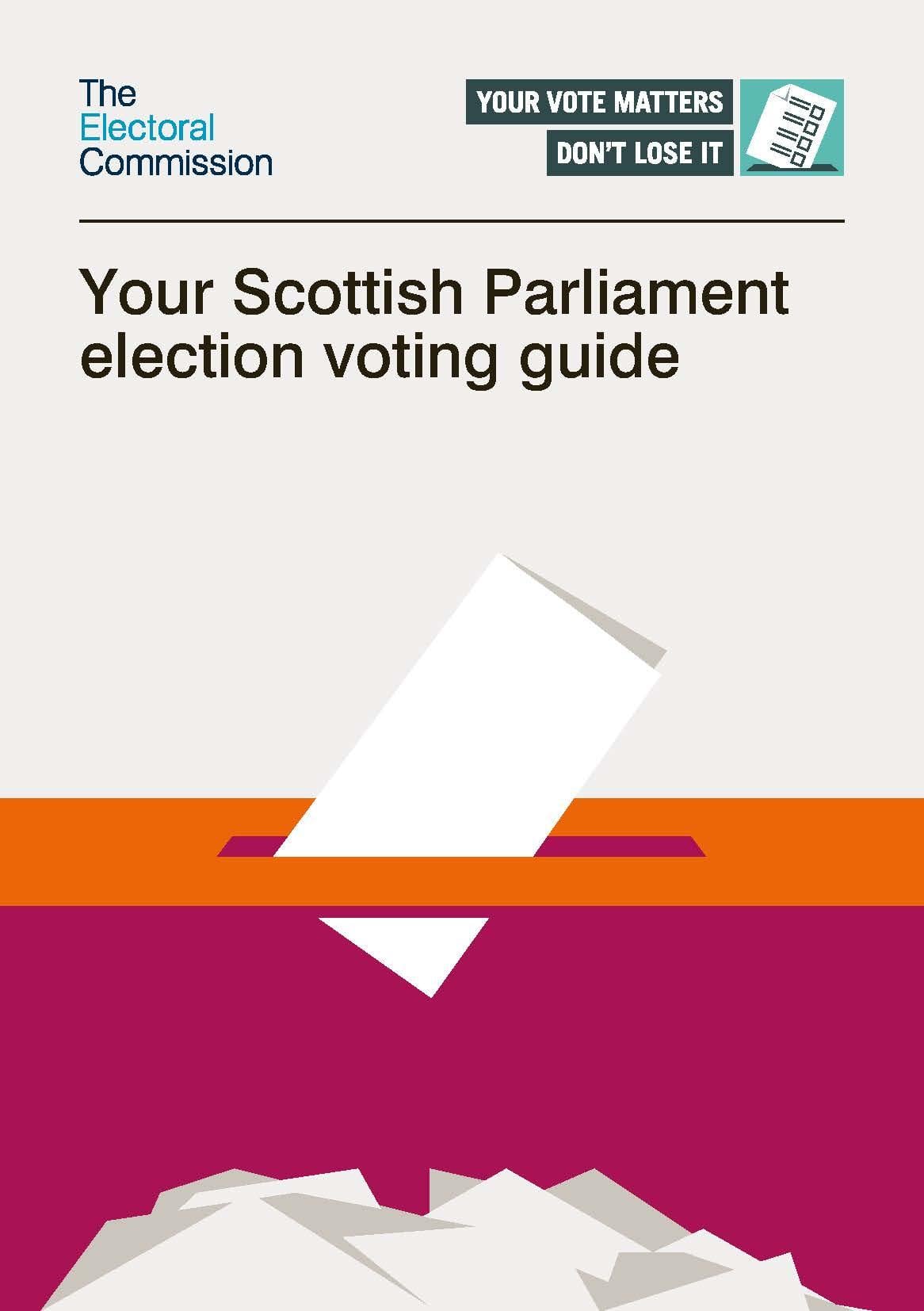
A voter information booklet for the Scottish Parliament election will be sent to all households in Scotland during the week commencing 23 March. The booklet contains key election and voting information and will be available in a range of accessible formats including Braille, British Sign Language (BSL) video, audio, Easy Read and large print, as well as in Ukrainian, Polish, Arabic and Gaelic.
To support young people to engage in the election the Commission has created political literacy resources for 14-18-year-olds and educators. The resources are designed to help young people understand what they can vote for, what to expect in elections, and how to cast their vote, so they feel confident to take part in upcoming elections and know that their vote matters. The resources include videos, quizzes, handbooks and PowerPoint presentations and they are available at www.electoralcommission.org.uk/learning.
The Commission is working with a range of partner organisations across Scotland to reach traditionally under-registered or disengaged voters as well as the newly enfranchised.
We have a number of resources available for partners who would like to share our voter information and registration messages on the democratic engagement section of our website including:
- ‘Welcome To Your Vote Week’ resources (posters, social graphics and copy, web banners)
- voter registration resources (posters, social graphics, web banners)
- political literacy resources for educators and young people
- voter registration newsletter
- 1. A qualifying foreign national is someone who has leave to remain in the UK or does not require such leave ↩ Back to content at footnote 1